Phonics worksheetsEnglish Updated
Free phonics worksheets: 47 printable PDF packs
47 free phonics worksheet packs, 282 printable pages, one for every word list on this site. Each pack moves from reading the words to hearing their sounds, writing the pattern, sorting and reading sentences, and ends with an answer key. Large type, lots of space, no sign-up.
- worksheet packs
- 47
- pages
- 282
- activities per pack
- 6
- answer keys
- ✓
- free to share
- CC BY
Free CVC worksheets
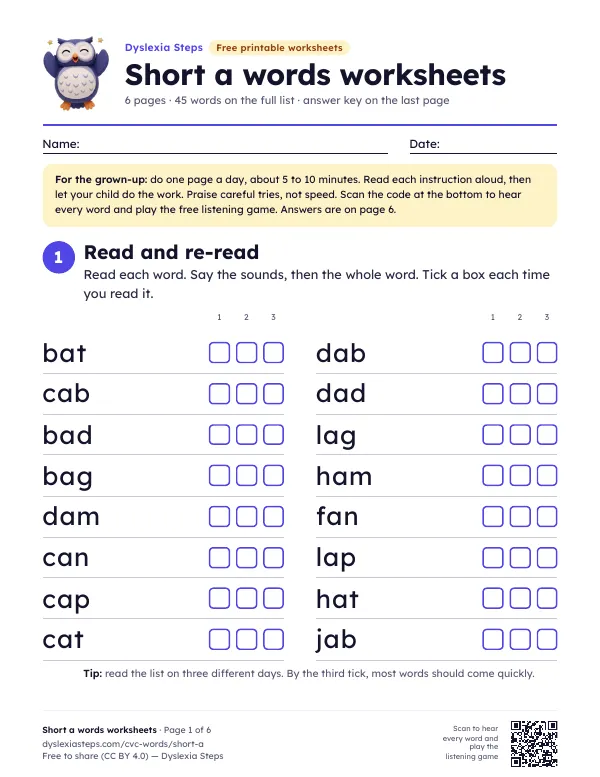
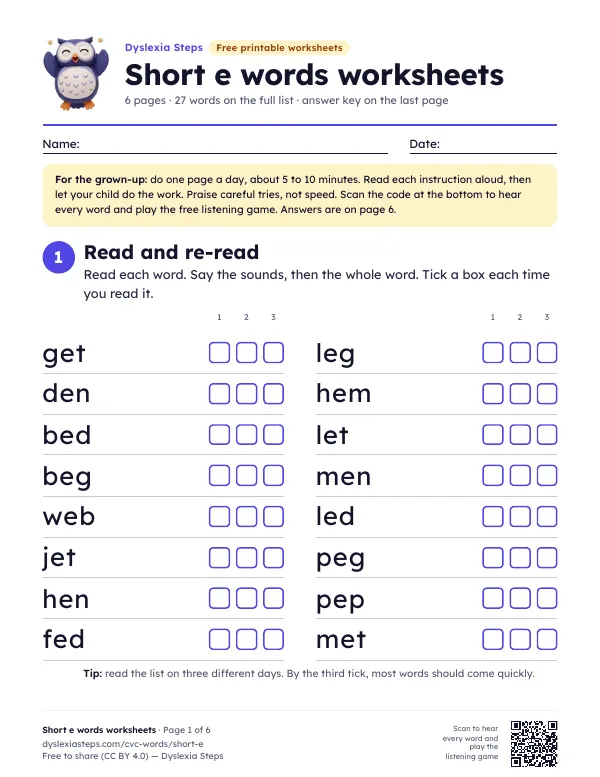
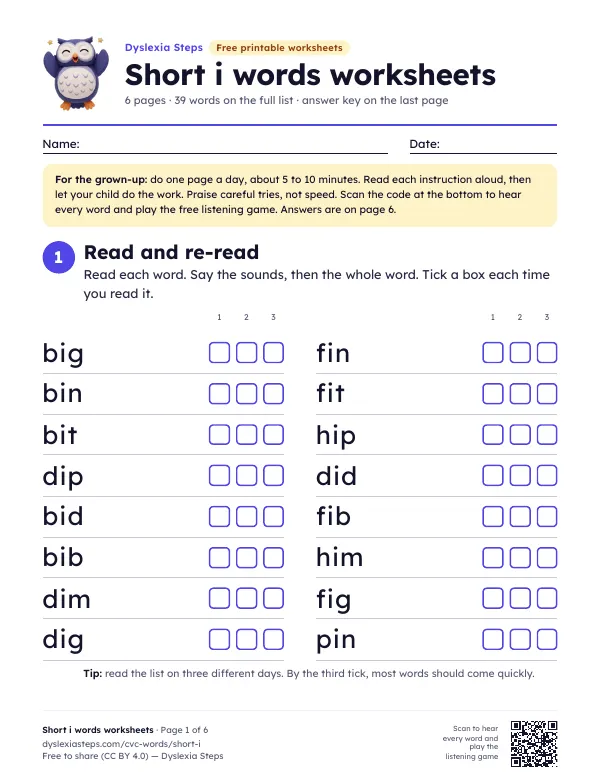
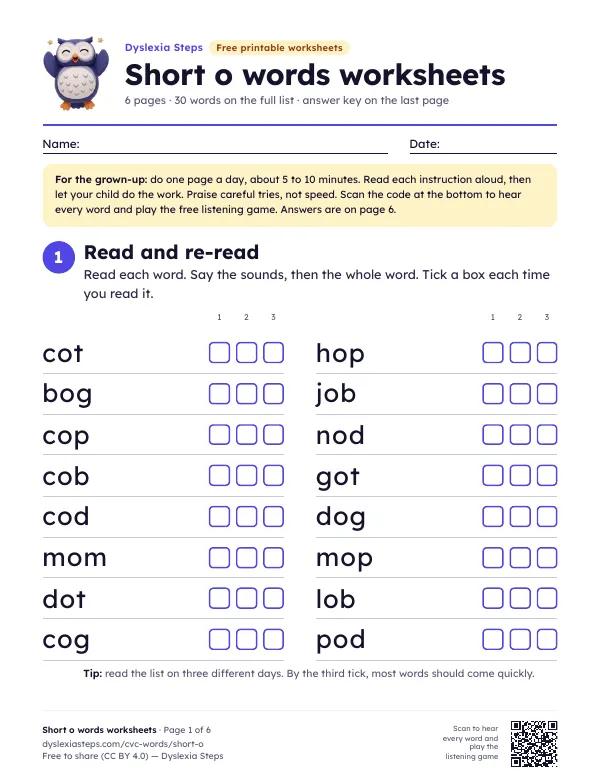
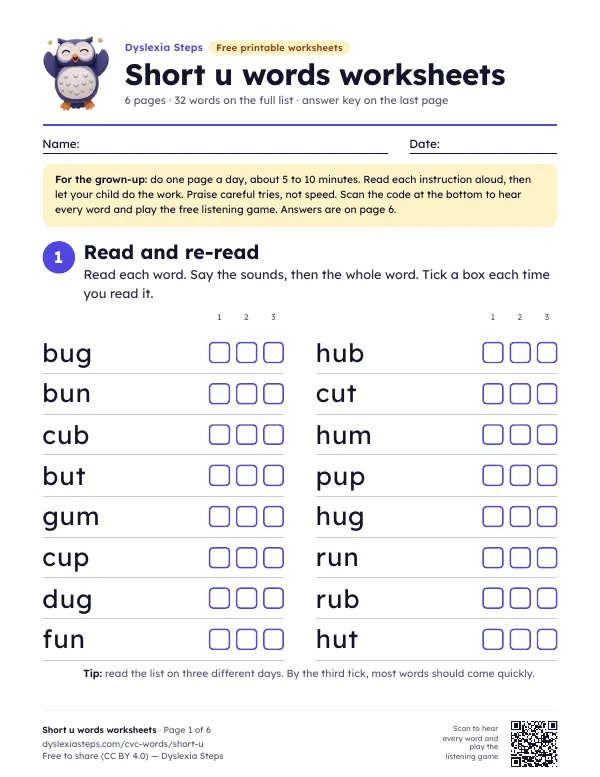
Start here. Each short vowel has its own pack of three-letter consonant–vowel–consonant words, so the vowel sound stays the same on every page and the sound boxes always need three boxes.
Free word family worksheets
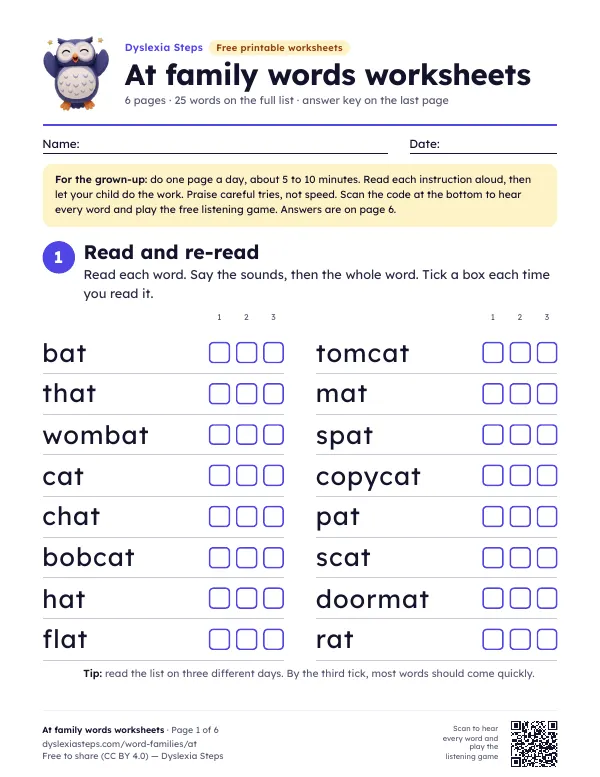
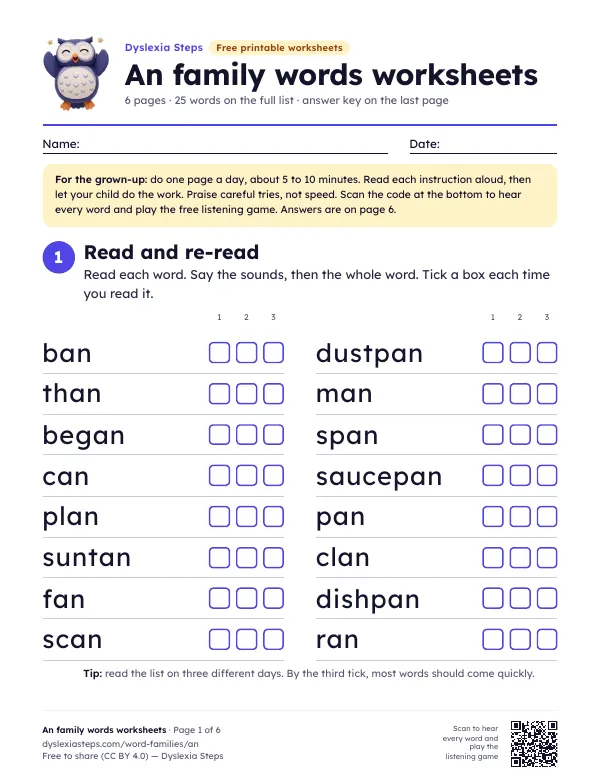
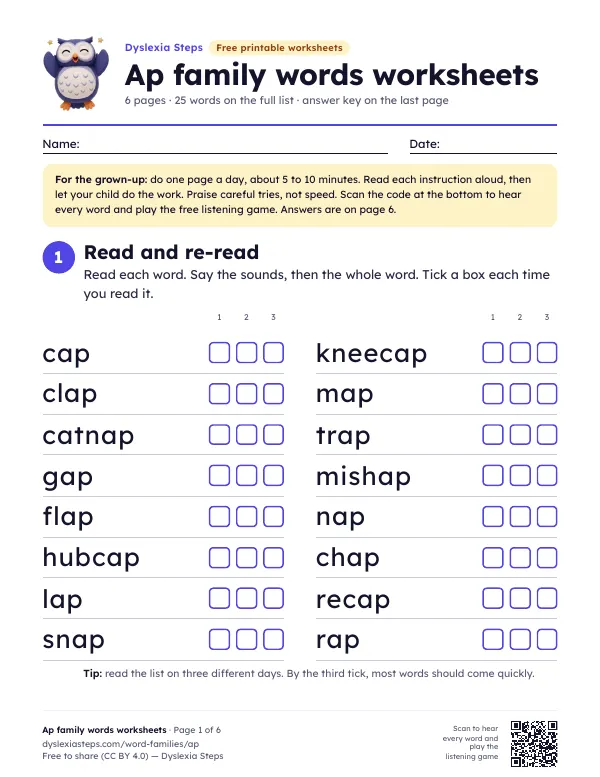
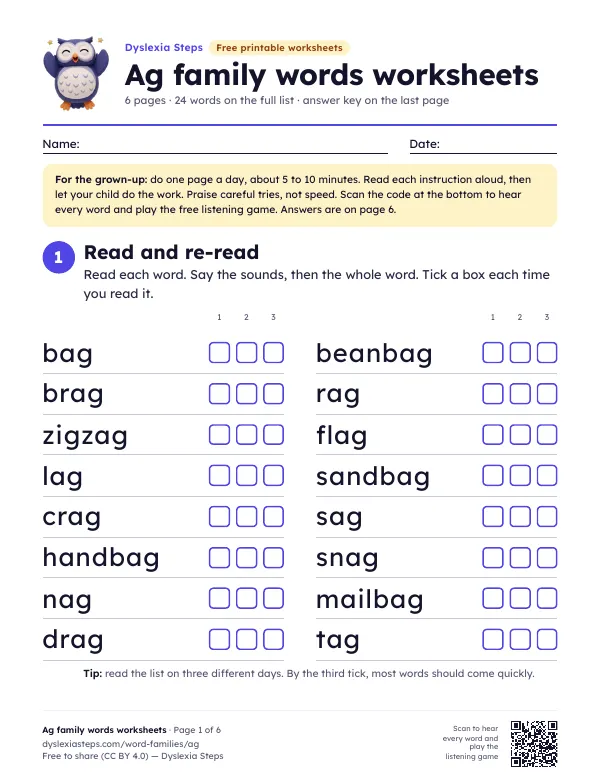
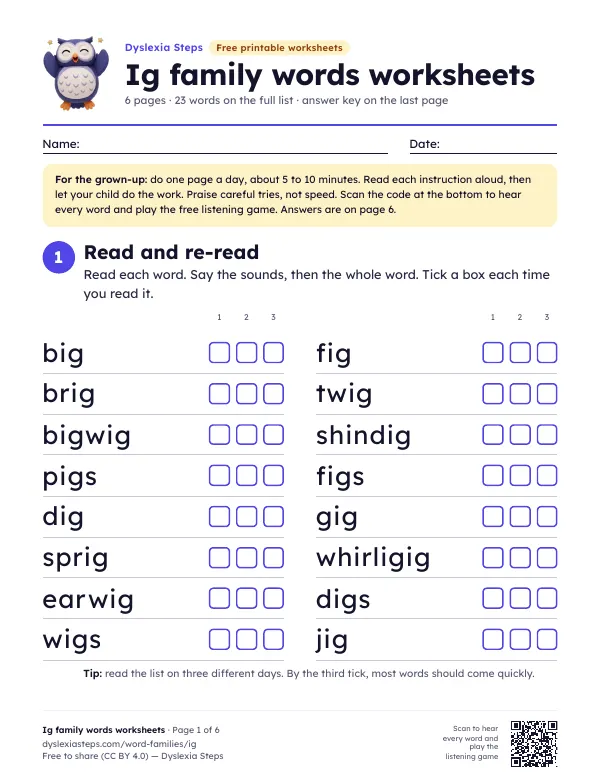
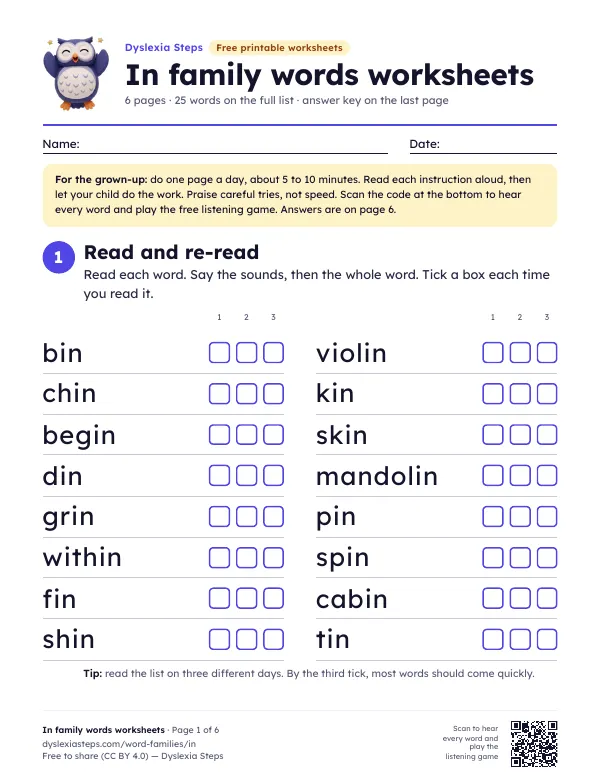
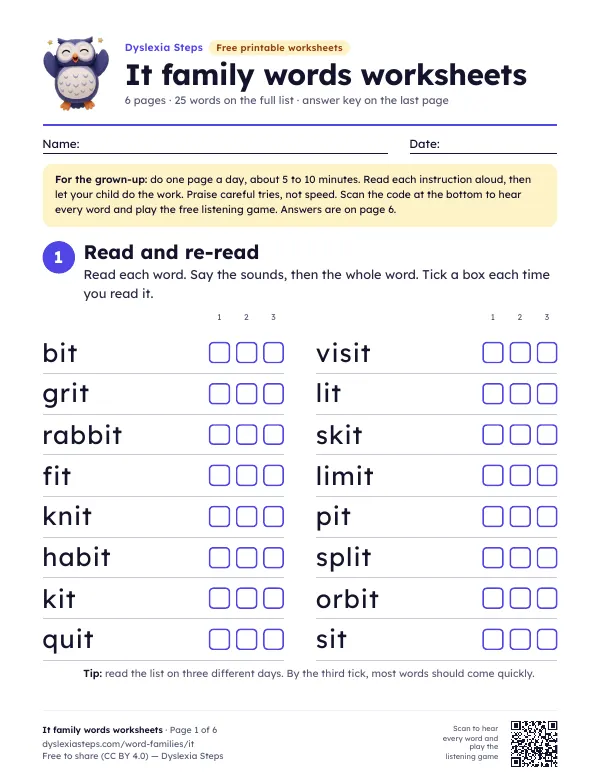
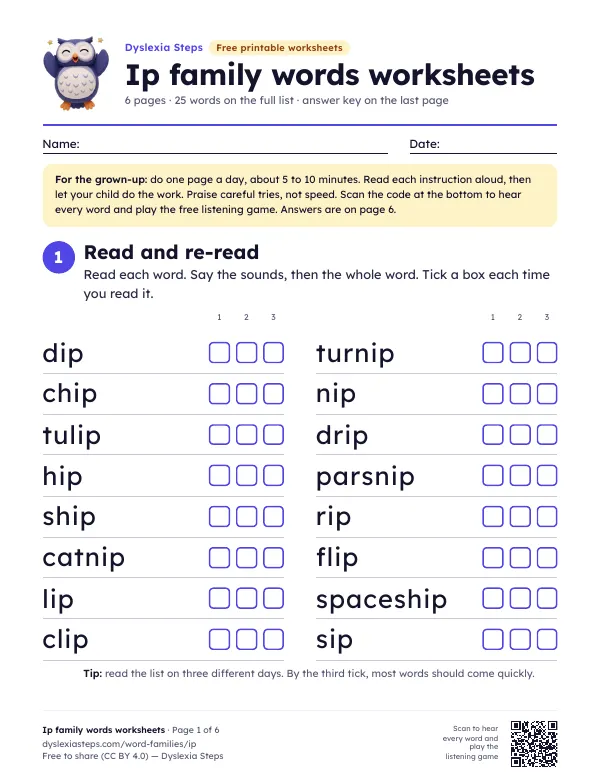
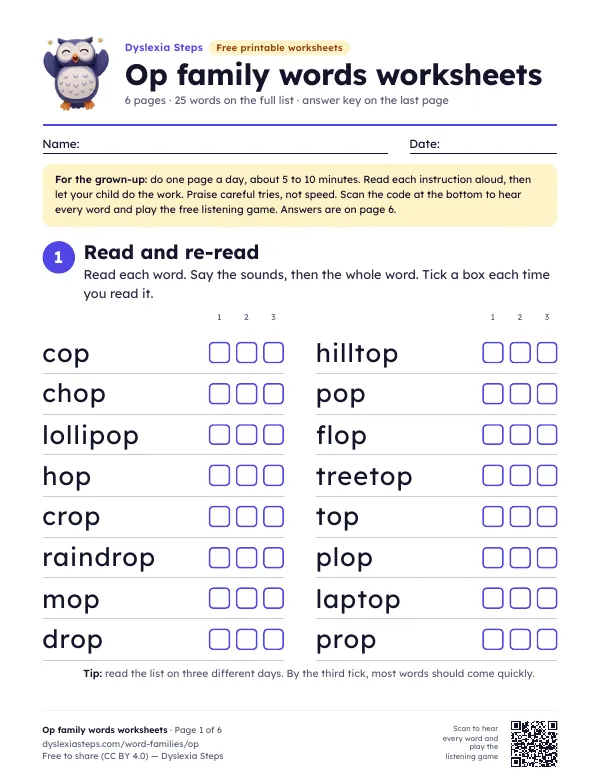
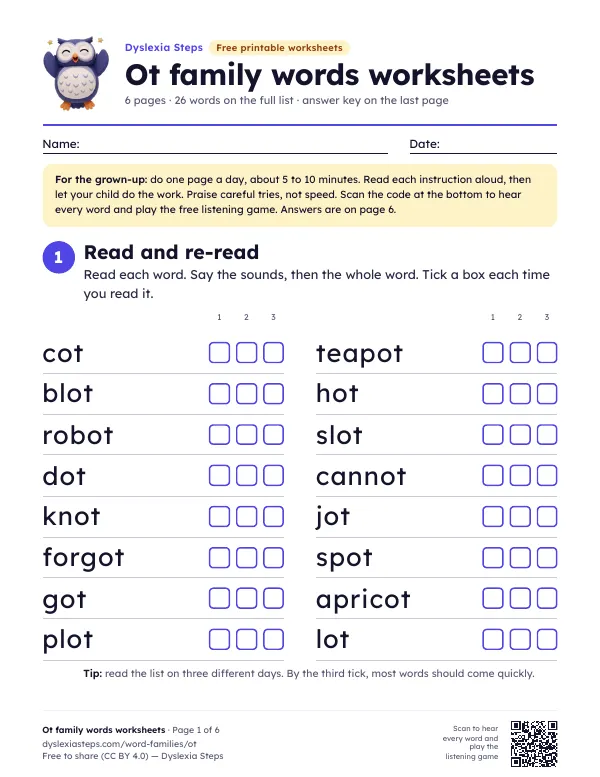
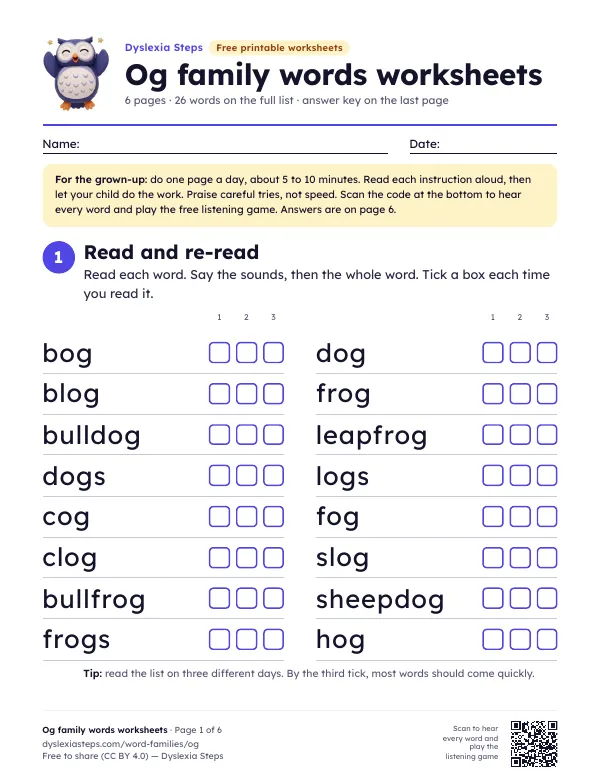
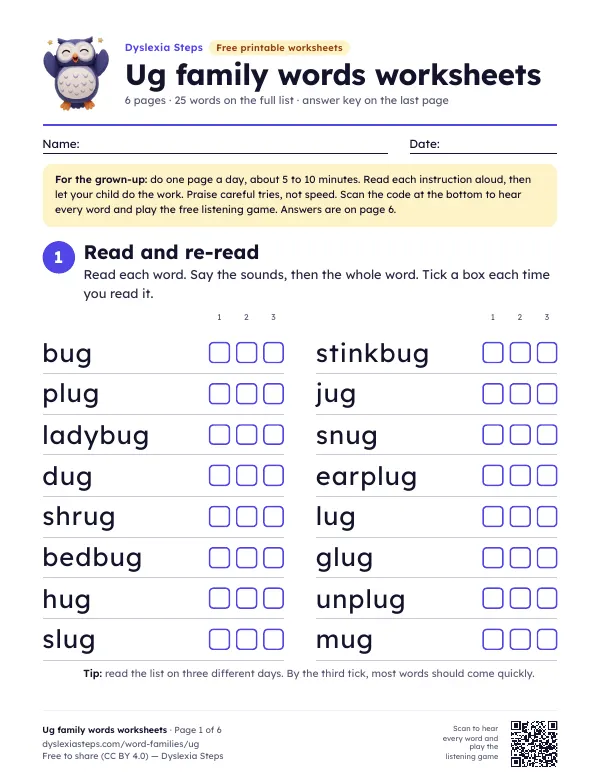
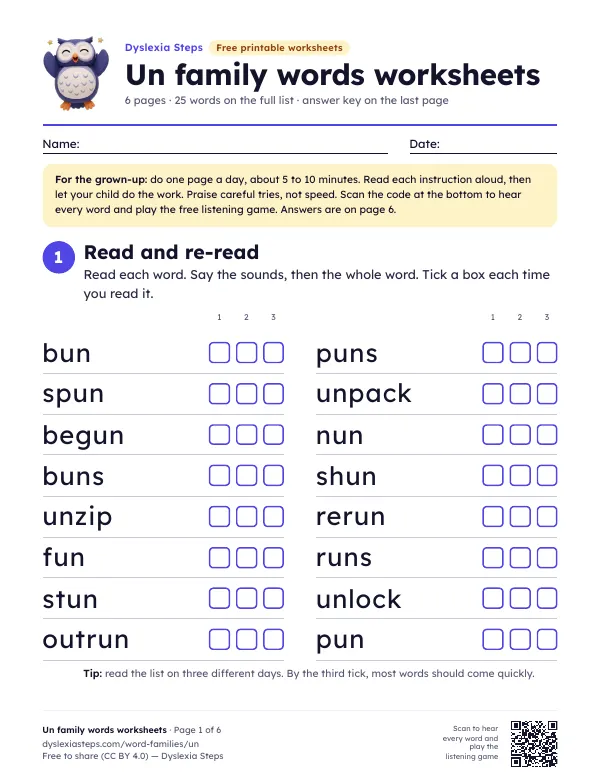
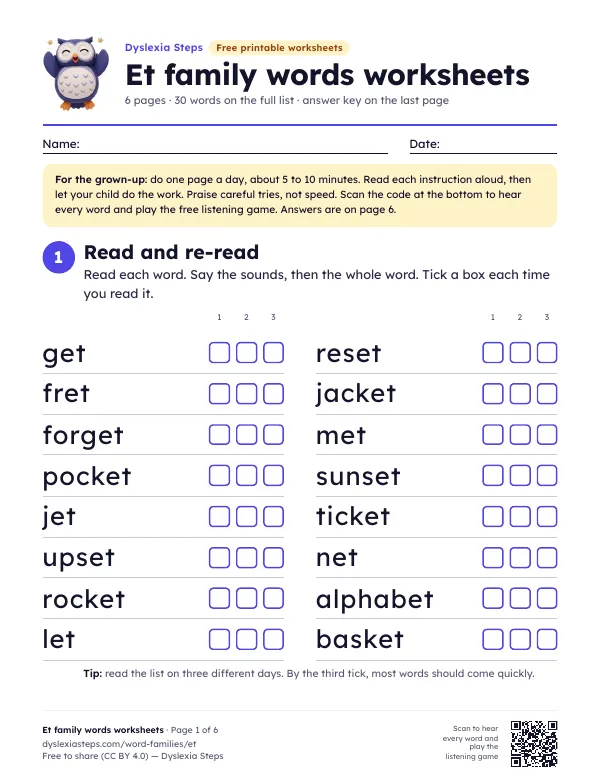
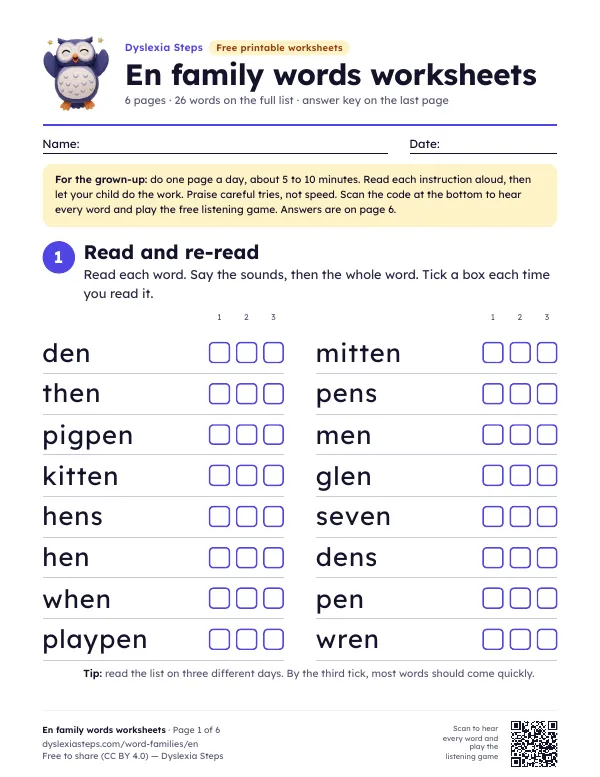
Fifteen word families, from -at to -en. The missing-letter page asks for the first sound, so your child makes their own real words; any real word counts, and the answer key lists the others.
Free sight word worksheets
The Dolch lists by grade, plus the Dolch nouns. Many sight words are not spelled the way they sound, so these packs use letter boxes instead of sound boxes, and a find-and-circle page with look-alike words such as was and saw.
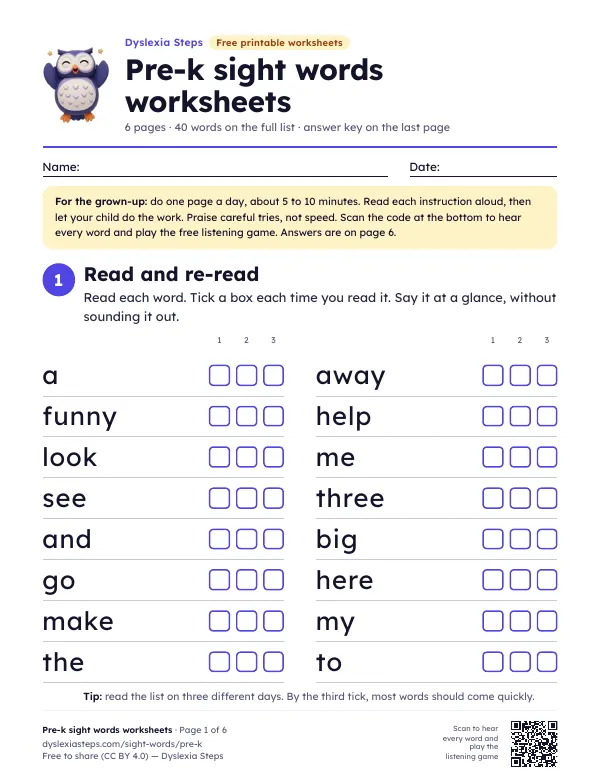
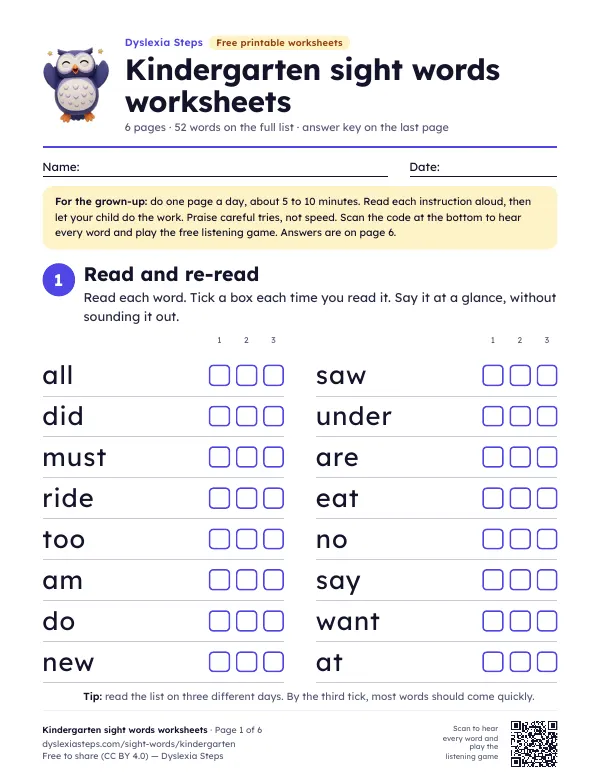
Kindergarten sight words worksheets
6 pages · 52-word list · 151 KB
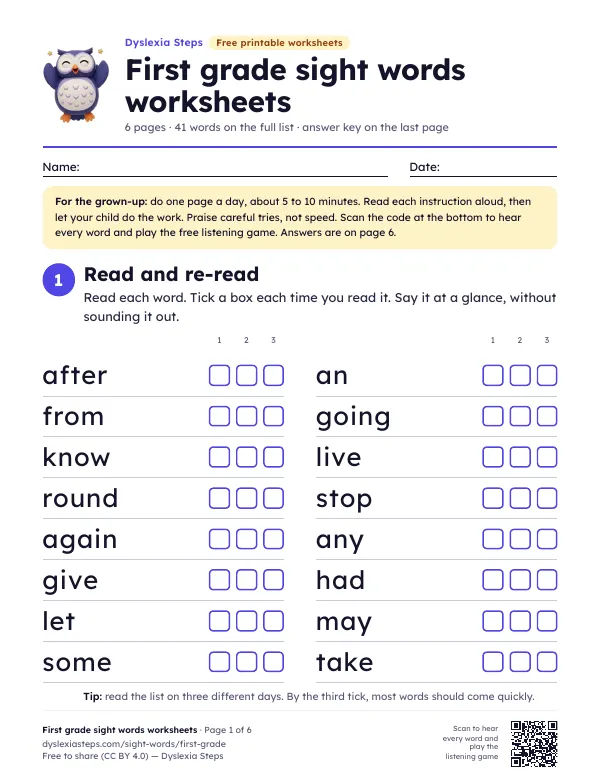
First grade sight words worksheets
6 pages · 41-word list · 152 KB
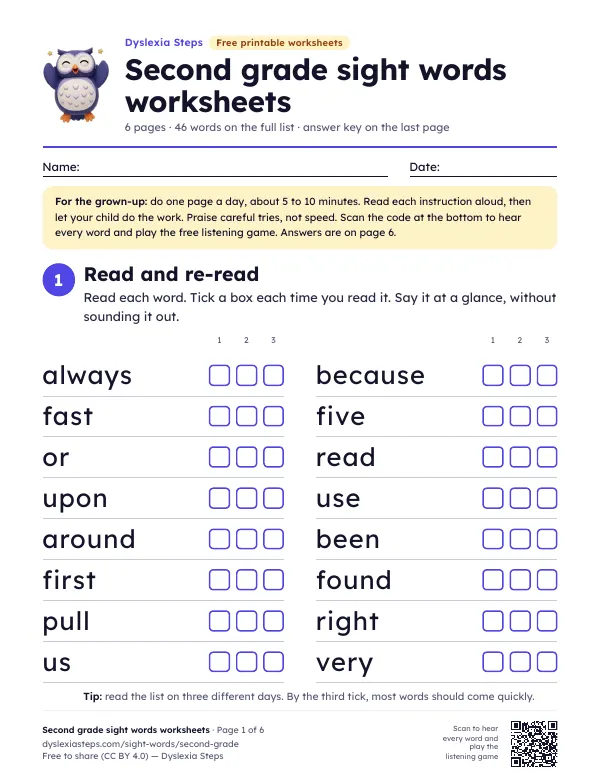
Second grade sight words worksheets
6 pages · 46-word list · 154 KB
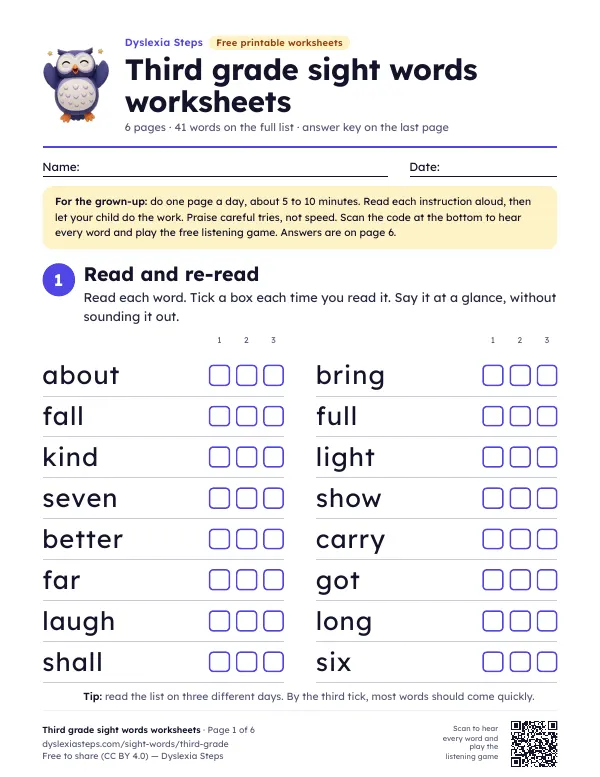
Third grade sight words worksheets
6 pages · 41-word list · 154 KB
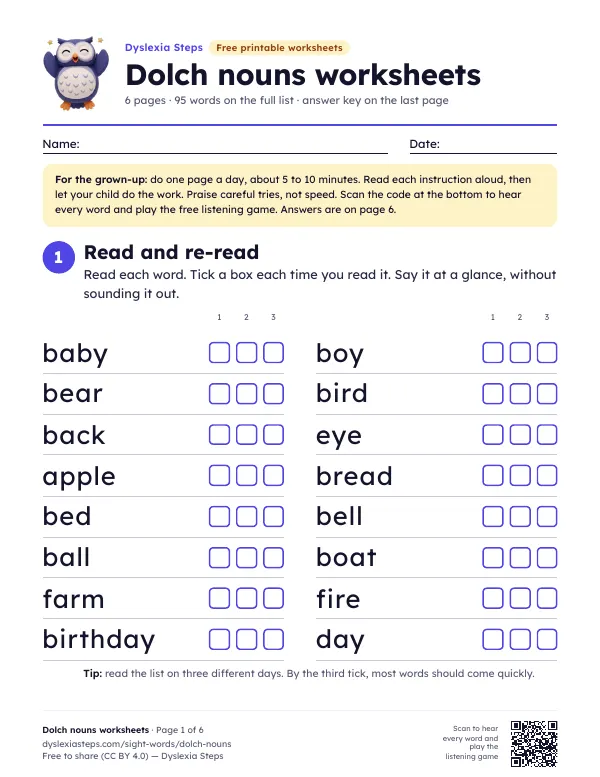
Free digraph worksheets
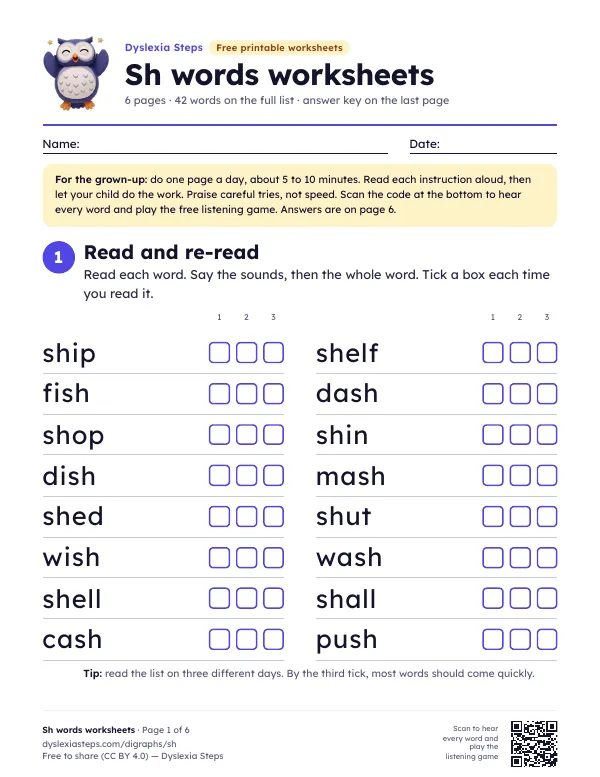
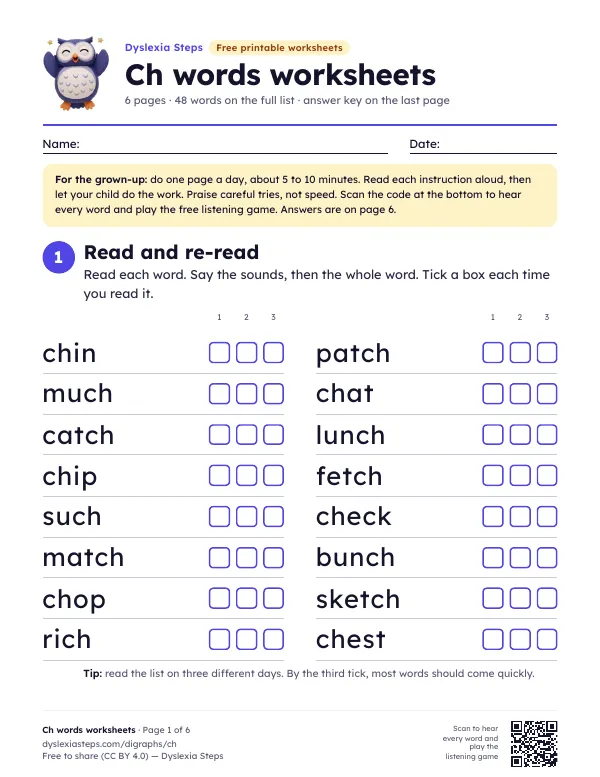
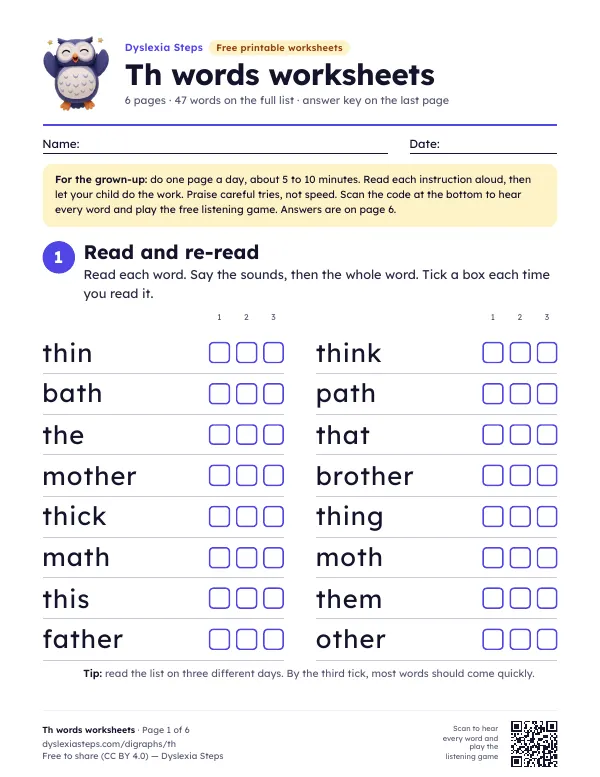
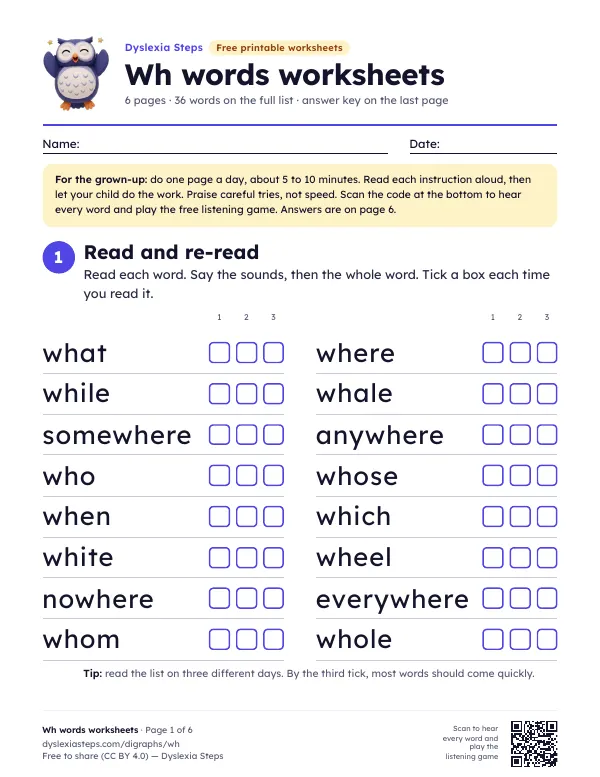
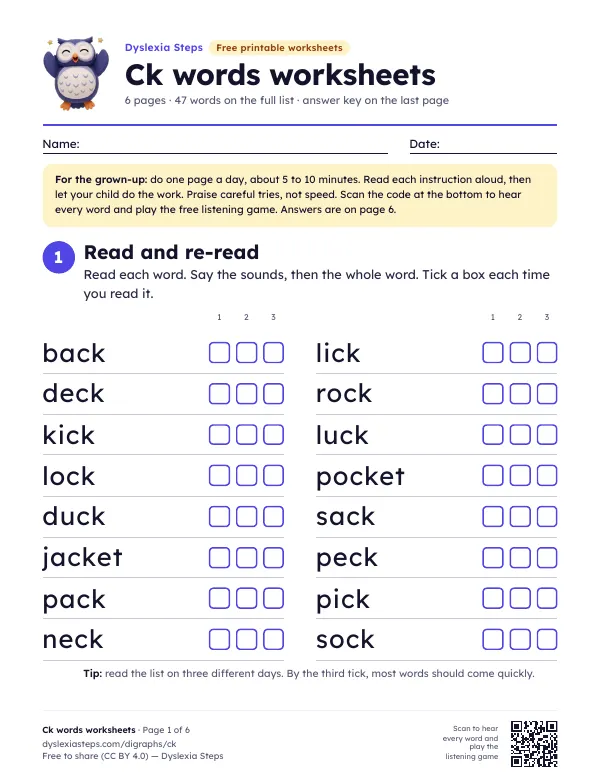
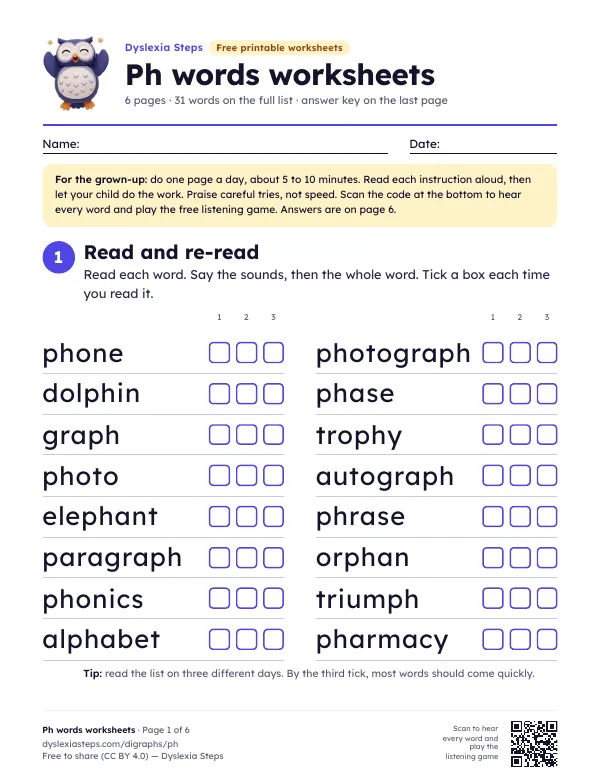
Two letters, one sound: sh, ch, th, wh, ck and ph. In the sound boxes the digraph shares one box, which is the whole point of the lesson.
Free long vowel and silent e worksheets
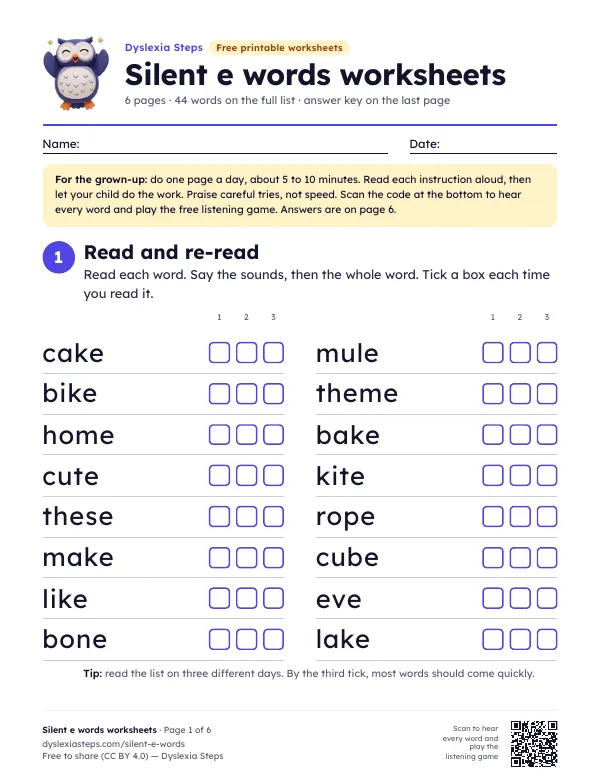
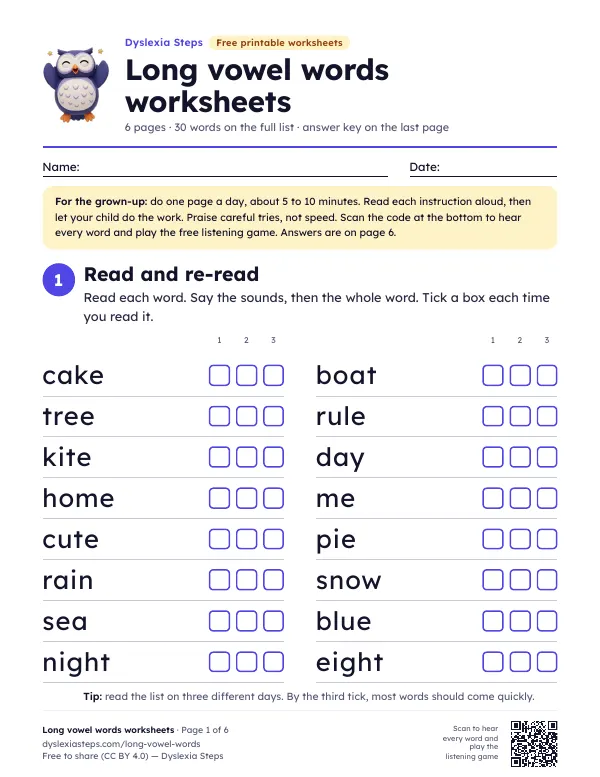
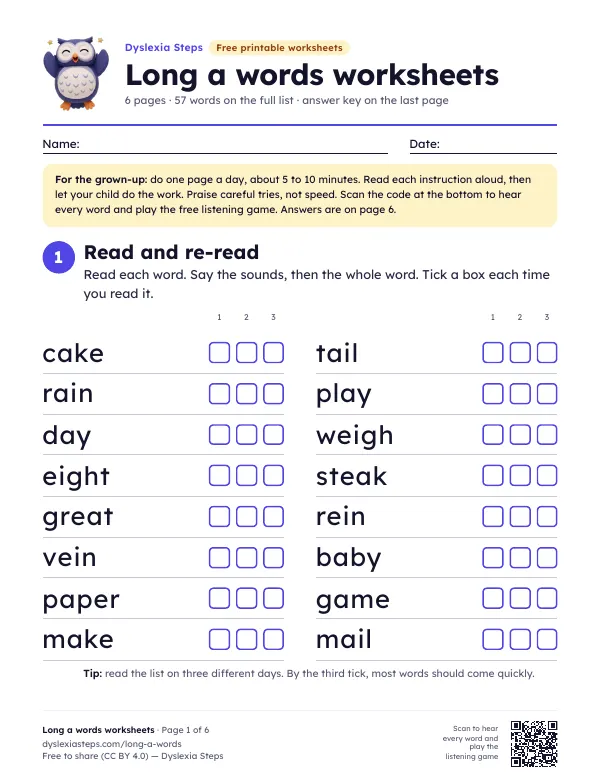
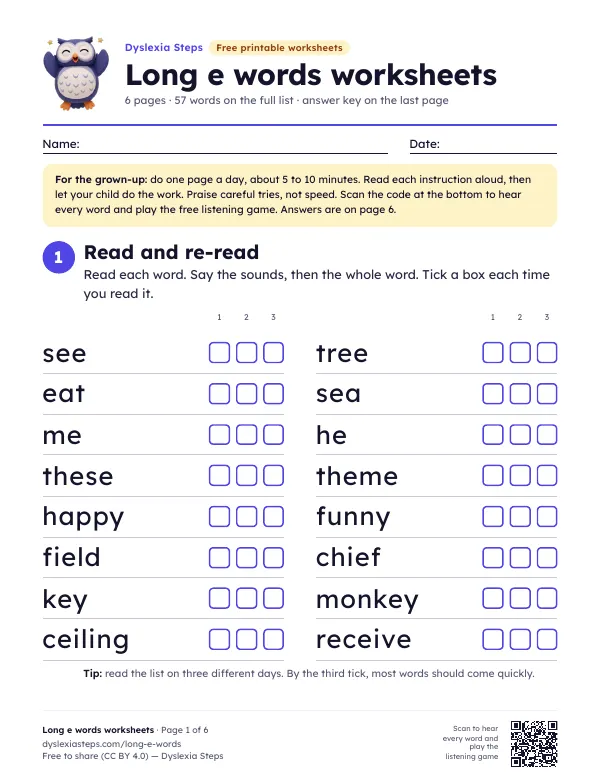
Silent e (cake, bike) and every common way to spell each long vowel. The silent e gets a dotted box: it is written but not heard.
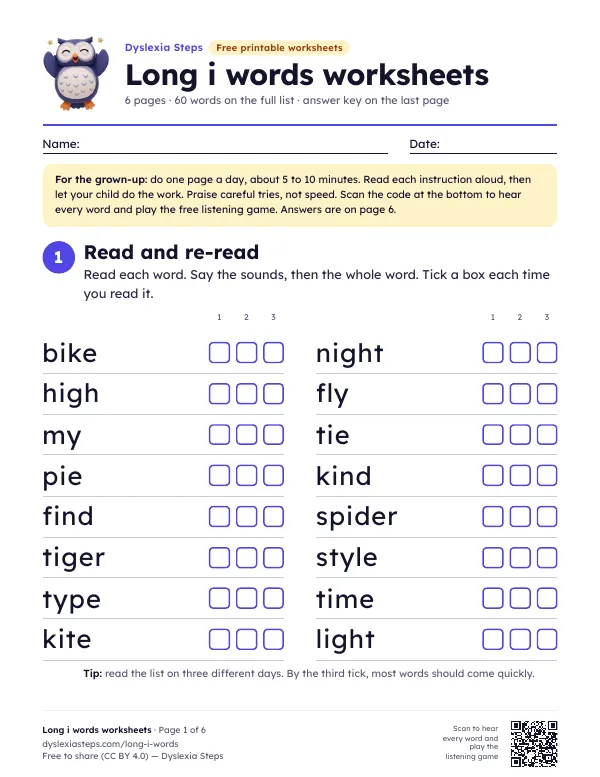
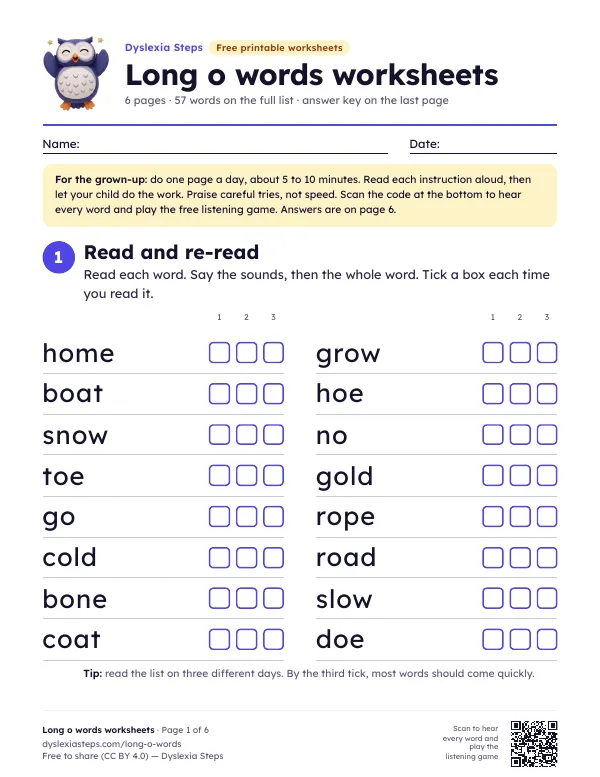
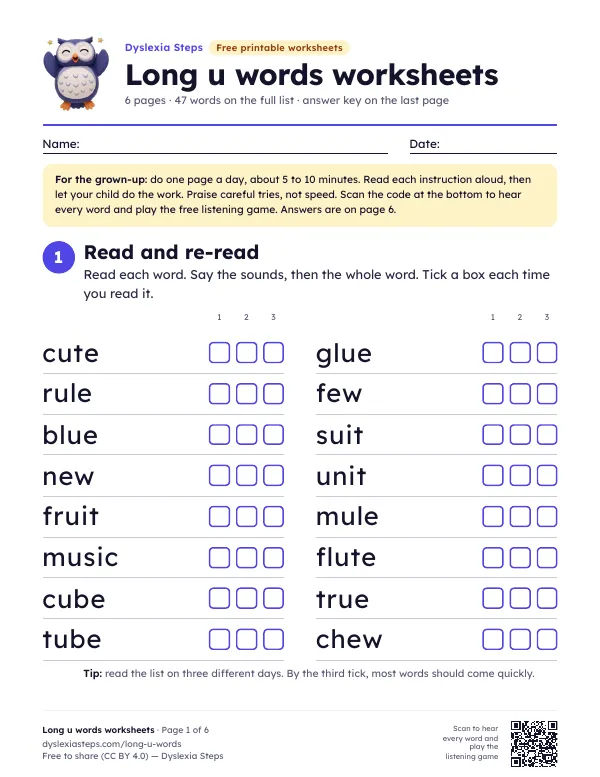
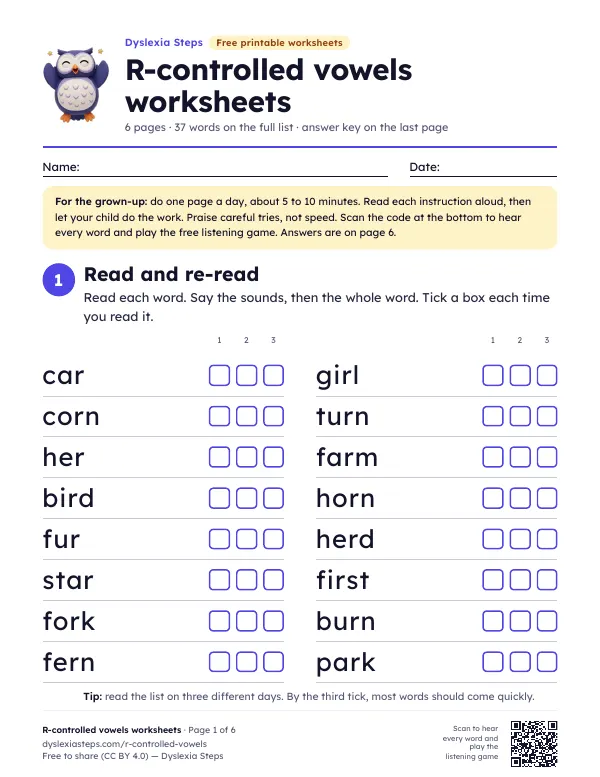
Free vowel team and r-controlled vowel worksheets
Vowel teams (ai, ee, oa, igh) and r-controlled vowels (ar, or, er, ir, ur). The missing-letter page only uses gaps where one spelling from the box makes a real word.
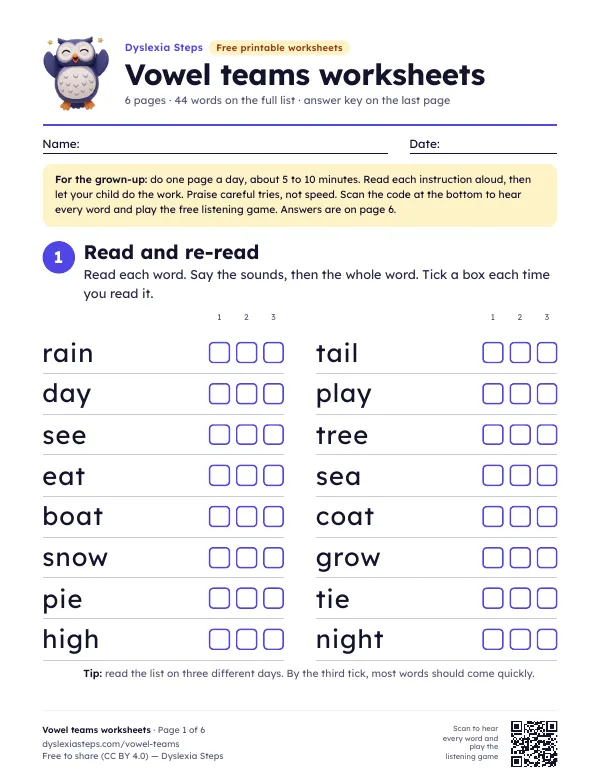
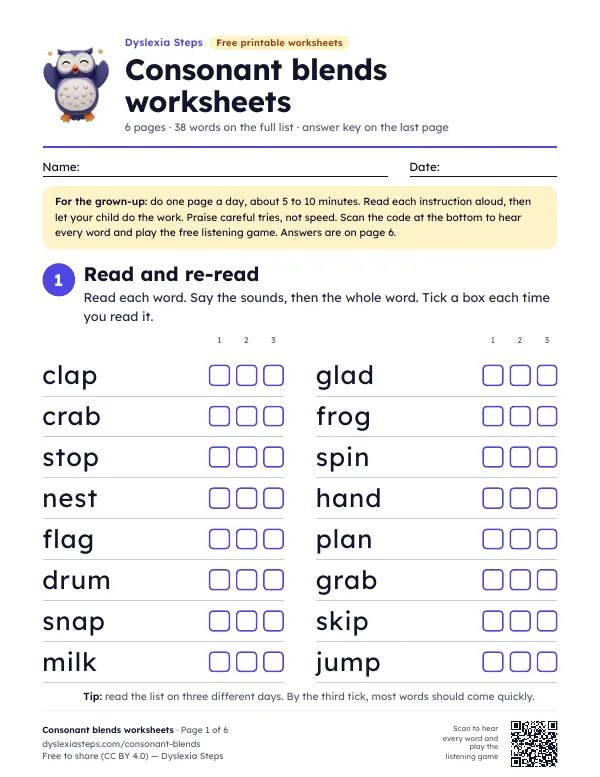
Free blend, spelling rule and fluency worksheets
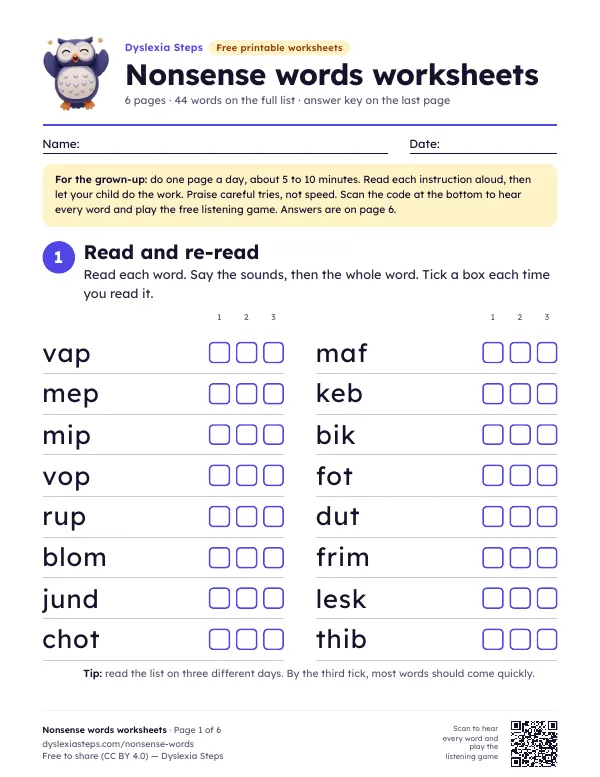
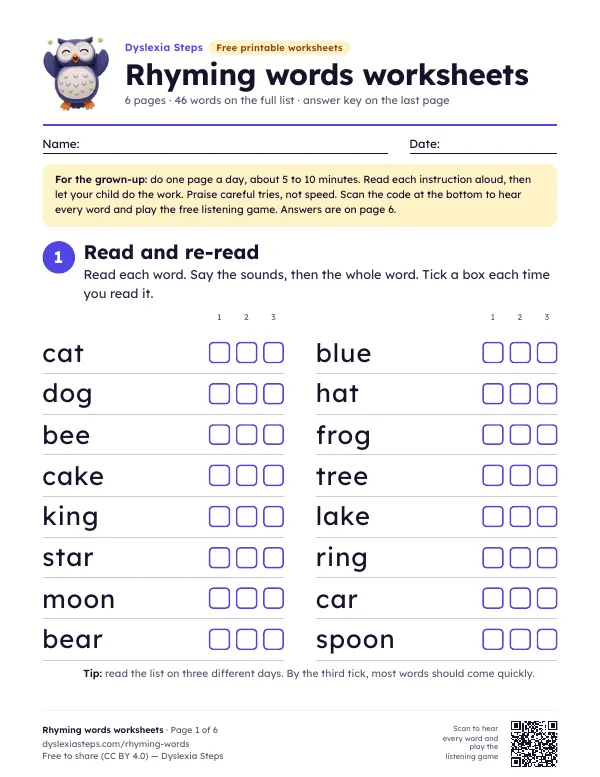
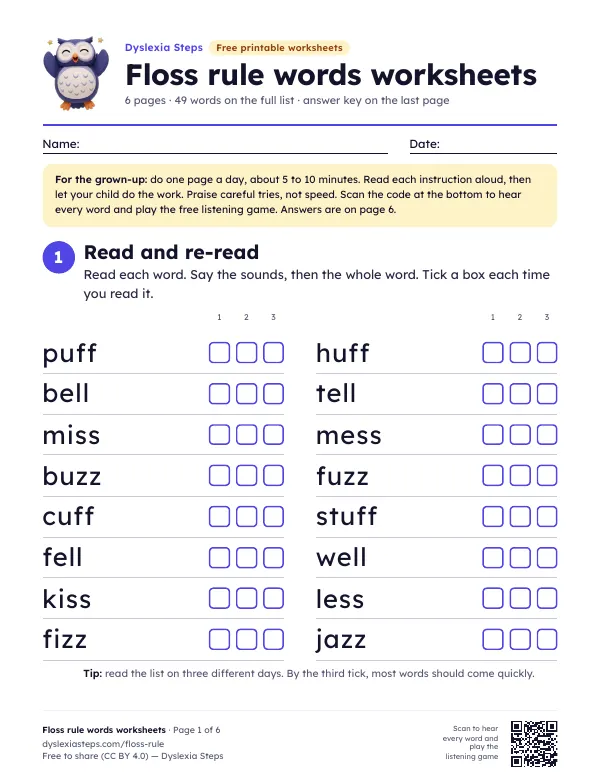
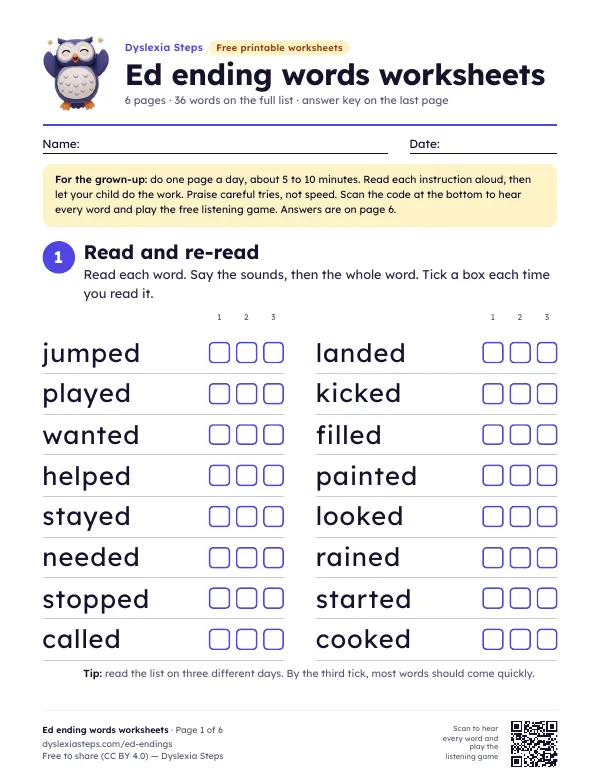
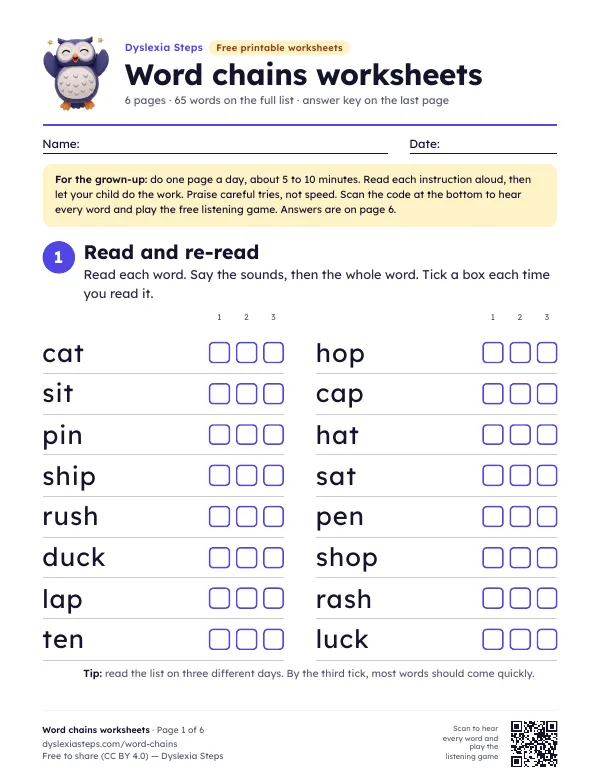
Consonant blends, the floss rule, -ed endings, rhyming words, word chains and nonsense words. The -ed pack also asks which sound the ending makes: /t/, /d/ or /id/.
What is in each free phonics worksheet pack
Every pack has the same six pages, so once your child knows the routine, all their effort goes into the sounds. Plan on one page a day, about five to ten minutes. The instructions are written to be read aloud by a grown-up.
- Read and re-read. Sixteen words from the list, each with three tick boxes. Read the list on three different days; most words should come quickly by the third tick. Repeated reading of the same words is one of the best-studied ways to build fluency.
- Sound boxes. One box for each sound. The first row is a worked example. Letter teams that make one sound, such as sh, ck or igh, share a box; a silent e gets a dotted box. Sight word packs use letter boxes instead, because many sight words do not follow the usual sound–letter rules.
- Missing letters. The pack's pattern is blanked out: the vowel in a CVC word, the first sound in a word family, the digraph, the vowel team or the blend. A box shows the spellings to choose from. Gaps are only used where one choice makes a real word, and where any letter would work (made-up words, word chains) the grown-up reads the word aloud.
- Word sort or find and circle. When a list has clear pattern groups (-at, -ab and -ad; /t/, /d/ and /id/), your child sorts the words into columns. Otherwise they find each word in a row of look-alikes such as was, saw and wsa, which asks for careful, letter-by-letter looking.
- Read the sentences. Short sentences built from the list, in large type with extra space between words. Your child underlines the pattern words and ticks each sentence once it reads smoothly.
- Answer key. On the last page, for the grown-up only.
Why sound box worksheets help with phonics
Reading starts with hearing that a spoken word is made of separate sounds: cat is /k/ /a/ /t/. Children who struggle to read often find this hard, and phonemic awareness practice, especially when it is linked to letters, helps children learn to read. Sound boxes (also called Elkonin boxes or word boxes) make the sounds visible: one box per sound, filled from left to right.
The boxes also show what a letter count hides. Ship has four letters but three sounds, so sh shares a box. Cake has four letters, three sounds and a silent e. Seeing that gap between letters and sounds is what lets a child spell words they have never practised. In a study with kindergartners at risk of reading problems, word box lessons improved phonemic awareness, letter–sound knowledge and spelling.
To use them, say the word slowly together. Your child pushes a coin, button or counter into a box for each sound, then writes the letters for each sound in its box, then reads the whole word again. If they get stuck, say the word once more, stretching each sound.
How to pick the right phonics worksheet pack
Choose the pack for the step your child can almost do. A common order is: CVC words with each short vowel, word families, digraphs, consonant blends, silent e, vowel teams and r-controlled vowels, then the long vowel spellings and endings such as -ed. Sight words run alongside, a few at a time. The word lists by grade show where each list usually sits, from Pre-K to Grade 3, but go by what your child can do rather than by their grade.
A quick check: read the sixteen words on page one together. If your child reads nearly all of them straight away, the pack is review; skip ahead. If they miss more than three or four, try the step before. The right pack feels like work for the first day and easy by the third.
Using the answer key and the audio
The answer key is on the last page so you can keep it aside. Check each page together while it is still fresh, and use mistakes to decide what to practise next: a wrong vowel means more work on that vowel, a missing sound in the boxes means more slow, stretched-out saying. On word family and rhyming pages any real word is right, so the key lists the other words your child might make.
Each page has a QR code that opens the matching word list, where every word has audio and there are two short games: listen and find the word, and build it from letter tiles. They are a good warm-up before a worksheet, or a reward after it.
Dyslexia-friendly worksheet design
The worksheets are designed to be easy on any child who finds reading hard: words to read are at least 20 points, lines and words have extra space, there is no italic text, no busy pictures and one activity per page. The type is Lexend, a clear sans-serif. We chose it because it is easy to read, not because a font fixes reading: studies of special dyslexia fonts have not found that they make reading better. What helps is explicit, regular practice with sounds and letters, which is what each page is for.
For b and d mix-ups, syllables and decodable fluency passages, see the free dyslexia worksheets.
If reading is still a struggle after plenty of practice, the free dyslexia test screens six reading skills in about 8 minutes. It is a screening, not a diagnosis.
Free to share (CC BY 4.0) — Dyslexia Steps. The worksheets are made from the site's word lists, which are CC BY 4.0 too.
Short answer
Where can I get free printable phonics worksheets?
Dyslexia Steps has 47 free phonics worksheet packs (282 pages) as PDFs, one for each of its word lists: CVC words, word families, sight words, digraphs, silent e, vowel teams, r-controlled vowels, blends and more. Every pack has the same six pages, from reading the words to writing them, and ends with an answer key.
- 47 packs, 282 pages, US Letter, free to print and share under CC BY 4.0.
- Each pack: read and re-read, sound boxes, missing letters, a word sort or find-and-circle, decodable sentences, and an answer key.
- Sound boxes give one box per sound, so letter teams like sh or igh share a box; a silent e gets a dotted box.
- Every page has a QR code back to the word list, where each word has audio and two short games.
Free phonics worksheets: frequently asked questions
Are these phonics worksheets really free?
Yes. All 47 packs are free PDFs with no sign-up. They are licensed CC BY 4.0, so teachers, tutors and parents can print, copy and share them, as long as the Dyslexia Steps credit on each page stays.
Which phonics worksheet should my child start with?
Start one step below where reading gets hard. Most children begin with short a words and the other CVC packs, then word families, digraphs such as sh words, blends, silent e and vowel teams. If a pack feels easy by the third read, move on; if more than two or three words on a page are wrong, go back one step.
What are sound boxes (Elkonin boxes)?
A row of boxes, one for each sound in a word. Your child says the word slowly, pushes a counter into a box for each sound, then writes the letters. Two letters that make one sound, such as sh or ee, share a box. Word box practice has been linked to better phonemic awareness and spelling in kindergartners at risk of reading problems.
Are these good dyslexia worksheets?
They follow the advice for children who find reading hard: one pattern per pack, explicit sound-by-sound practice, short pages, large type and lots of white space, no italics and no busy pictures. They are practice sheets, not a test. If reading stays hard despite regular practice, our free dyslexia test screens six reading skills in about 8 minutes.
How do I use the answer key?
Check the page together as soon as it is done, and treat each mistake as a clue to the sound to practise next. Put tricky words on the next day's re-read list. On word family and rhyming pages any real word is right, so the key lists the other words your child might make.
Can I print the worksheets on A4 paper?
Yes. The packs are US Letter, but choosing "fit to page" in the print dialog scales them to A4; the margins are wide enough that nothing is cut off.
Sources
- Keesey S, Konrad M, Joseph LM (2015). Word boxes improve phonemic awareness, letter-sound correspondences, and spelling skills of at-risk kindergartners. Remedial Spec Educ, 36(3), 167-180.
- Ehri LC, Nunes SR, Willows DM, Schuster BV, Yaghoub-Zadeh Z, Shanahan T (2001). Phonemic awareness instruction helps children learn to read: evidence from the National Reading Panel's meta-analysis. Read Res Q, 36(3), 250-287.
- Therrien WJ (2004). Fluency and comprehension gains as a result of repeated reading: a meta-analysis. Remedial Spec Educ, 25(4), 252-261.
- Cheatham JP, Allor JH (2012). The influence of decodability in early reading text on reading achievement: a review of the evidence. Read Writ, 25(9), 2223-2246.
- Wery JJ, Diliberto JA (2017). The effect of a specialized dyslexia font, OpenDyslexic, on reading rate and accuracy. Ann Dyslexia, 67(2), 114-127.