Phonics word listEnglish Updated
The ap word family: -ap words list
Ap family words: 25 words in 3 groups, each with audio you can tap to hear. Practise them with two games (listen and find, build the word), 8 decodable sentences and a printable worksheet.
- words
- 25
- groups
- 3
- games
- 2
- sentences
- 8
- printable
- 🖨
Free dyslexia reading game
Ap family words game: listen and find
Hear a word from the list and pick it from four look-alike words. Eight rounds, about two minutes.
- Free
- In your browser
- No download
- No sign-up
- 8 rounds
- about 2 min
- audio
Cap, map, nap and tap all end in -ap. The family is large, so it is great for practice once -at feels easy. Hear the words, read the sentences and play the game.
Ap family words list (25 words)
Tap a word to hear it.
CVC -ap words
-ap words with blends and digraphs
Longer words ending in -ap
Free dyslexia reading game
Ap family words spelling game: build the word
Hear a word and build it from letter tiles, one sound at a time. Letter pairs like sh or ck come as one tile, because they spell one sound. Six rounds.
- Free
- In your browser
- No download
- No sign-up
- 6 rounds
- audio
Short answer
What is the ap word family?
The ap word family is the group of words that end in the rime -ap, short a followed by p, as in cap, map, nap and tap. Children read them by blending the first sound onto -ap: m + ap, map. There are ten common three-letter -ap words, and the family grows with blends such as clap, snap and trap and longer words such as catnap, hubcap and mousetrap.
- The rime -ap is short a /a/ followed by /p/, as in map.
- Common three-letter -ap words: cap, gap, lap, map, nap, rap, sap, tap, yap and zap.
- In wrap the w is silent, so wrap sounds the same as rap.
- Adding a silent e makes long a words: cap becomes cape and tap becomes tape.
About ap family words
The -ap rime is short a followed by /p/, a sound made by closing the lips and releasing a small puff of air. Children can feel it if they hold a hand in front of their mouth while saying map. Because p is a quick, stopped sound, it helps to say the vowel clearly first and then close the lips: m-aaa-p.
With ten three-letter words, -ap gives lots of practice at the simplest level. The second group has blends that stretch a child a little further. Clap, flap and snap begin with two consonants that are both heard, strap and scrap begin with three, and chap begins with the digraph ch. Wrap is the odd one: its w is silent, which is worth pointing out rather than leaving your child to puzzle over.
The longer words are mostly compound words, two small words joined together: cat + nap, hub + cap, mouse + trap. Covering one half with a finger and reading each part separately shows a child that a long word is often just two short ones. Unwrap and recap add a beginning chunk instead, un- and re-, which children will meet again in many other words.
Ap family words in sentences
Decodable sentences: every word can be sounded out with the patterns on this page, plus a few very common words.
- The cat had a nap on my lap.
- Tap the map with the cap.
- Clap and snap for the band.
- Wrap the cap in a bag.
- The dog can yap at the trap.
- Look at the gap in the strap.
- Dad had a catnap in the van.
- Unwrap the scrap of red cloth.
Printable ap family words worksheets (free PDF)
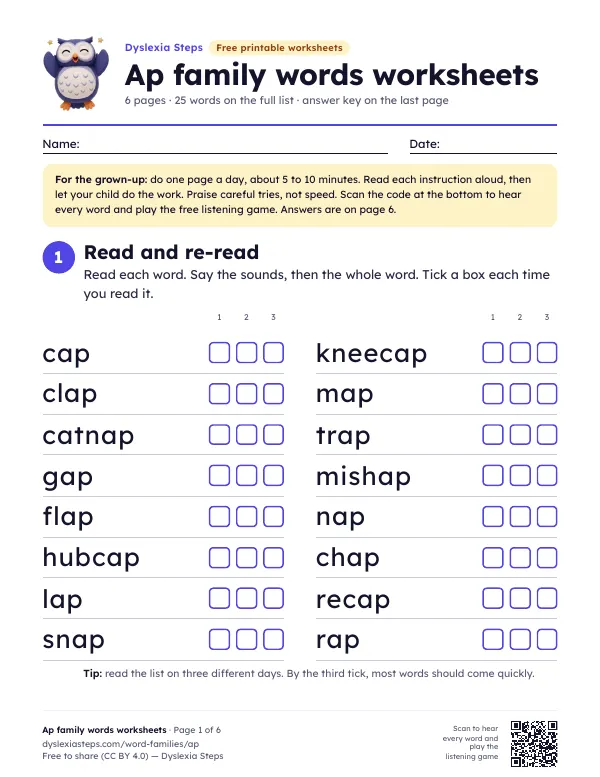
A 6-page pack built from this list, in large, clear type with plenty of space to write. Print it on US Letter paper; scan the code on each page to come back to the audio and the games.
- 1. Read and re-read: 16 words, three ticks each
- 2. Sound boxes: one box per sound, with a worked example
- 3. Missing letters: write the pattern into 10 words
- 4. Word sort: sort the words by pattern
- 5. Read the sentences: 8 short sentences to read aloud
- 6. Answer key for the grown-up
Free to share (CC BY 4.0) — Dyslexia Steps. Copy it for your class or your family.
Common mix-ups with ap family words
-ap and -op (map and mop)
Map and mop differ only in the vowel. Children reading from the first letter may say either. Put the pair side by side, say both, and ask your child to point to the one with /a/.
p and b at the end (cap and cab)
P and b are made in the same place with the lips; b uses the voice, p does not. Have your child touch their throat while saying cab and cap to feel the buzz on b.
Cap and cape, tap and tape
A silent e turns short a into long a. If cape is read as cap, cover the e, read, uncover, read again, and let your child say what changed.
Ap family words activities
Clap and read
Say an -ap word and clap once for the first sound and once for -ap. Then clap both together while saying the word. For longer words like mousetrap, clap each syllable.
Treasure map
Draw a simple map with -ap words written at each stop. Your child reads each word to move along the path to the treasure. Add a few -op words as trick stops so the vowel has to be checked.
Snap cards
Make pairs of -ap and -at cards. Turn them over one at a time; when two cards from the same family appear in a row, the first to say snap and read both words keeps them.
Wrap it up
Wrap small objects or pictures (a cap, a map, a toy trap) in paper. Your child unwraps one, says its name, and writes it with magnetic letters, saying each sound while placing the letter.
Ap family words: frequently asked questions
What words are in the ap word family?
Cap, gap, lap, map, nap, rap, sap, tap, yap and zap are the three-letter ones. Longer -ap words include clap, flap, snap, trap, strap, scrap, wrap, catnap, hubcap, mishap and mousetrap.
Why is wrap spelled with a w?
Wr is an old spelling where the w used to be pronounced. Today it is silent, so wrap sounds like rap. Children usually learn wr later, with other silent letter pairs like kn.
Should -ap come before or after -at?
Usually after -at and -an, because p is a little harder to hear at the end of a word than t or n. By then the short a sound is already familiar.
How can I tell if my child is really reading -ap words?
Mix -ap with -op and -ip words, and add a few made-up words like jap or vap. A child who is blending will read them all; a child who is guessing from the ending will make mistakes on the vowel.