Phonics word listEnglish Updated
The en word family: -en words list
En family words: 26 words in 5 groups, each with audio you can tap to hear. Practise them with two games (listen and find, build the word), 8 decodable sentences and a printable worksheet.
- words
- 26
- groups
- 5
- games
- 2
- sentences
- 8
- printable
- 🖨
Free dyslexia reading game
En family words game: listen and find
Hear a word from the list and pick it from four look-alike words. Eight rounds, about two minutes.
- Free
- In your browser
- No download
- No sign-up
- 8 rounds
- about 2 min
- audio
Den, hen, men, pen and ten all end in -en, and so do then and when. Hear every word, from wren to kitten and seven, read the sentences and play the game.
En family words list (26 words)
Tap a word to hear it.
CVC -en words
-en words with blends and digraphs
Longer words where -en is clear
Longer words where -en sounds weak
-en words with s
Free dyslexia reading game
En family words spelling game: build the word
Hear a word and build it from letter tiles, one sound at a time. Letter pairs like sh or ck come as one tile, because they spell one sound. Six rounds.
- Free
- In your browser
- No download
- No sign-up
- 6 rounds
- audio
Short answer
What is the en word family?
The en word family is the group of words that end in the rime -en, the short e sound followed by n, as in den, hen, men, pen and ten. Children read them by blending the first sound onto -en: h + en, hen. The family includes the common words then and when, and longer words such as pigpen and playpen. In words like kitten, seven and garden the -en is unstressed and sounds weak.
- The rime -en is short e /e/ followed by /n/, as in hen.
- Common three-letter -en words: den, hen, men, pen and ten.
- In parts of the southern United States, pen and pin sound the same.
- In two-syllable words like kitten, seven and oven, -en is unstressed and sounds weaker than in hen.
About en family words
The -en rime is short e followed by /n/. Because n is a humming sound, the chunk can be stretched, eeennn, which helps blending. In General American English, though, short e before n can drift toward short i, and in many southern accents pen and pin sound the same. When practising, say the vowel clearly so your child hears the difference, even if everyday speech blurs it.
The CVC group is small, just den, hen, men, pen and ten, so the second group matters more. Then and when are among the most useful words in any reading book. Then starts with the digraph th, and when with wh, which in most American speech sounds just like w. Wren has a silent w, so it pairs well with wrap and write later on.
Most longer -en words have the stress on the first syllable, so the -en at the end is weak: kitten, mitten, seven, garden, chicken, kitchen, open. The spelling is -en, and children can decode it that way before saying the word naturally. Pigpen and playpen are compounds, so the pen keeps its full sound. The last group adds s to show that hens and pens keep the chunk.
En family words in sentences
Decodable sentences: every word can be sounded out with the patterns on this page, plus a few very common words.
- Ten hens sat in the pen.
- When is the hen in the den?
- The men got a red pen.
- Then the kitten had a nap.
- A wren sat in the glen.
- Put the mitten in the wooden box.
- The chicken is in the kitchen.
- Open the oven and get the buns.
Printable en family words worksheets (free PDF)
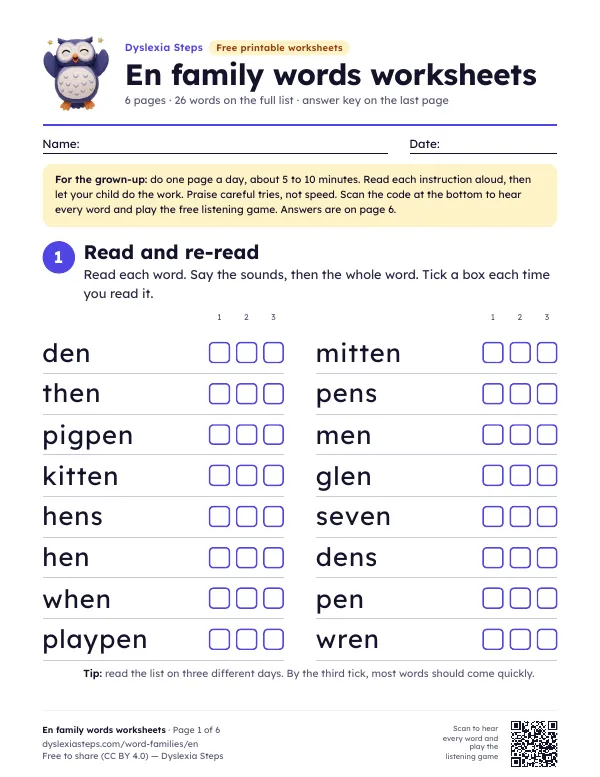
A 6-page pack built from this list, in large, clear type with plenty of space to write. Print it on US Letter paper; scan the code on each page to come back to the audio and the games.
- 1. Read and re-read: 16 words, three ticks each
- 2. Sound boxes: one box per sound, with a worked example
- 3. Missing letters: write the pattern into 10 words
- 4. Word sort: sort the words by pattern
- 5. Read the sentences: 8 short sentences to read aloud
- 6. Answer key for the grown-up
Free to share (CC BY 4.0) — Dyslexia Steps. Copy it for your class or your family.
Common mix-ups with en family words
-en and -in (pen and pin)
In many American accents, especially in the South, these two sound the same. For reading practice, exaggerate the vowels, p-eee-n and p-iii-n, and let your child see that e opens the mouth a little more.
Then and when
Both are common and both start with a digraph. If your child mixes them, underline th and wh, say each sound, and read the two words in short sentences: then we ran; when did we run?
-en and -an (men and man)
Men and man differ only by the vowel, and ten/tan and pen/pan work the same way. Read the pairs side by side; man is one, men is more than one.
En family words activities
Hen house count
Draw a hen house with ten doors. Behind each door write an -en word. Your child opens one door at a time, reads the word, and counts up to ten.
Pen and pin sort
Mix -en and -in word cards. Your child reads each card aloud with a clear vowel and sorts it under a picture of a pen or a pin.
Then and when story
Tell a very short story together using then and when on cards: when the hen sat, then the kitten ran. Your child holds up the right card as each word is needed.
Clap the kitten
For longer words, your child claps the syllables, kit-ten, sev-en, gar-den, then reads the word with a strong clap on the first part and a soft one on -en.
En family words: frequently asked questions
What words are in the en word family?
The three-letter ones are den, hen, men, pen and ten. Longer words include then, when, glen, wren, pigpen and playpen, plus two-syllable words such as kitten, seven, garden and chicken.
Why do pen and pin sound the same to us?
The pin-pen merger is a normal feature of several American accents, especially in the South. It does not affect reading, but spelling practice is easier if the vowels are exaggerated.
Is when in the en family?
Yes. When ends in -en, and wh sounds like w for most American speakers, so it reads w + en. It is one of the most common question words children meet.
Should I teach -en before -et?
Either order works. Many teachers start with -et because t is a clear ending and short e is easier to hear before t than before n.