Dyslexia worksheetsEnglish Updated
Free dyslexia worksheets: 11 printable PDF packs
11 free dyslexia worksheet packs, 55 printable pages: b and d, syllables and decodable fluency passages. Each pack works on one skill, in large type with plenty of space, and ends with an answer key or a reading tracker. About ten minutes a day. No sign-up.
- worksheet packs
- 11
- pages
- 55
- decodable stories
- 15
- answer keys
- ✓
- free to share
- CC BY
Free b and d worksheets
Three packs for b and d mix-ups: at the start of a word, at the end, and inside blends. Each one links the letter to its sound first (listen, then write b or d), then asks for careful looking, sorting and reading.
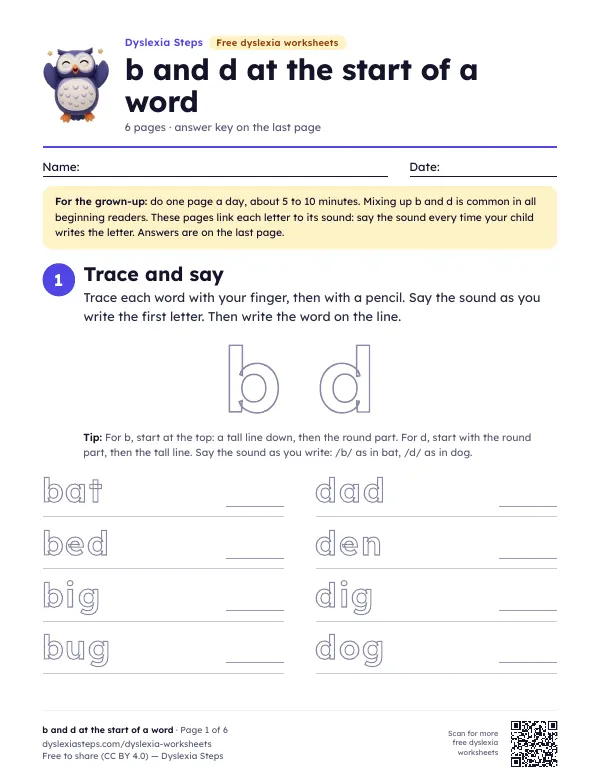
b and d at the start of a word
bat or dad? Short words that start with b or d.
6 pages · 156 KB
Download PDF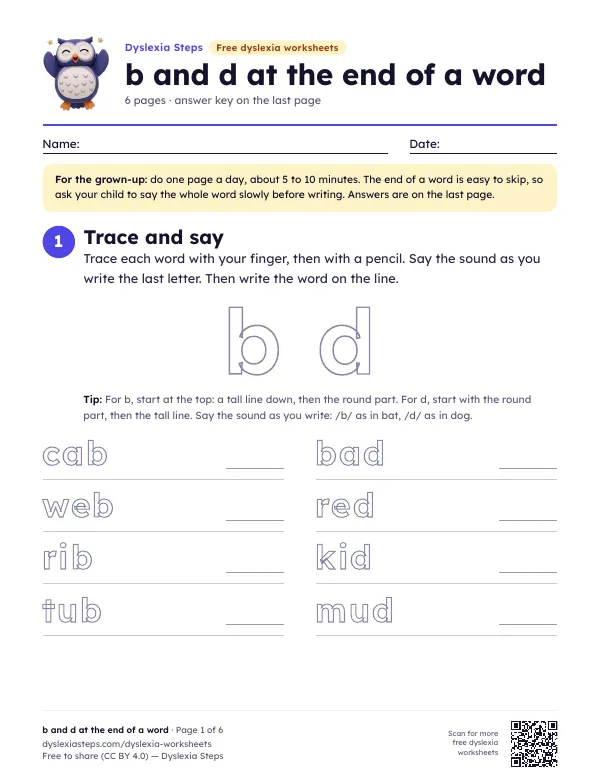
b and d at the end of a word
cab or sad? Short words that end with b or d.
6 pages · 158 KB
Download PDF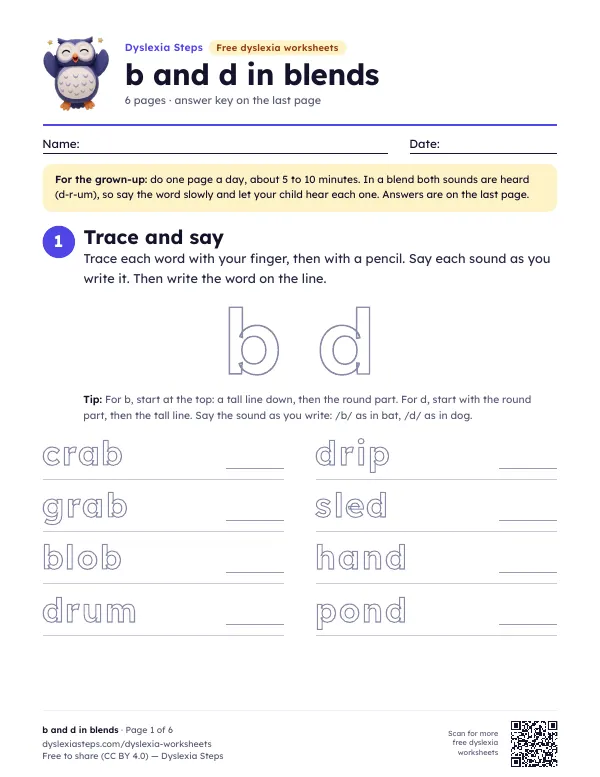
Free syllable worksheets
Three packs that take longer words apart: clap and count syllables, split compound words, and divide two-syllable words between the consonants (rab|bit, nap|kin).
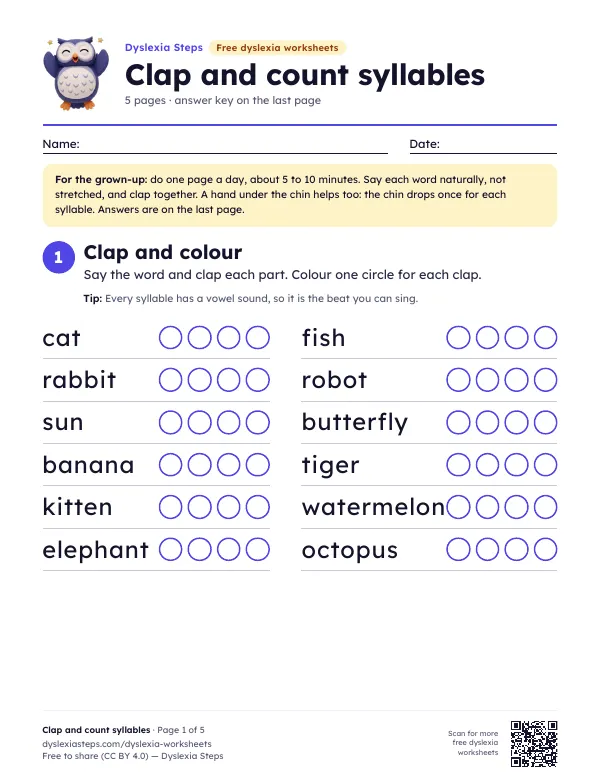
Clap and count syllables
Clap, count and sort words with 1 to 4 syllables.
5 pages · 150 KB
Download PDF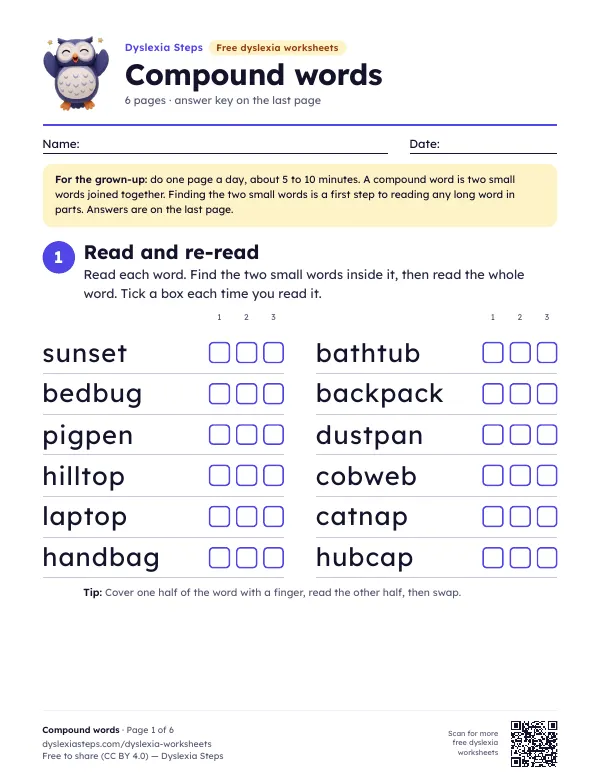
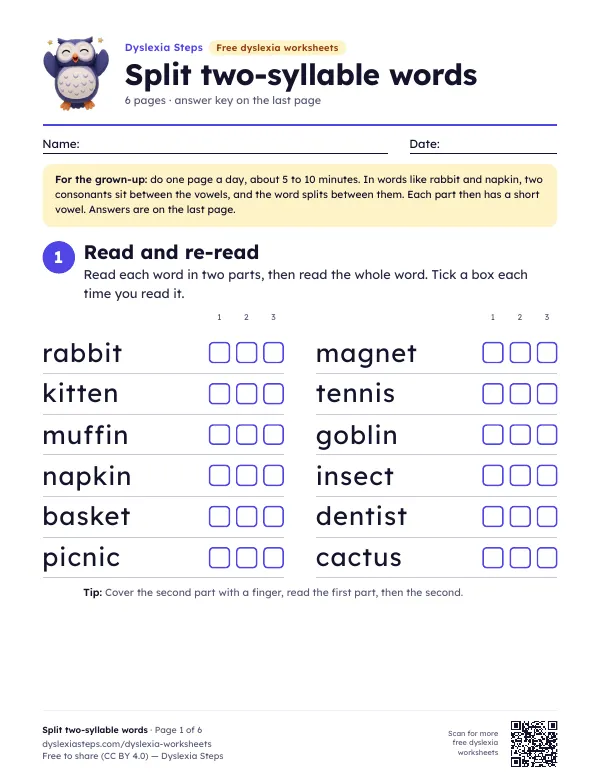
Split two-syllable words
rab|bit, nap|kin: split between the two consonants.
6 pages · 142 KB
Download PDF
Free decodable fluency passages
Five packs of short stories, one for each teaching step. Every word uses only the sounds taught up to that step, plus common sight words, so your child can read the story instead of guessing. Each pack has a one-minute reading tracker.
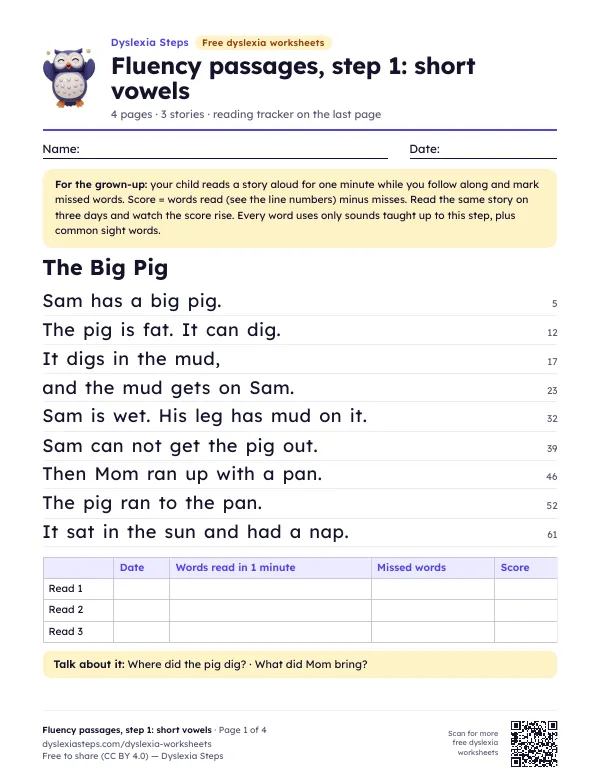
Fluency passages, step 1: short vowels
Three stories with CVC words only (cat, mud, pig).
4 pages · 105 KB
Download PDF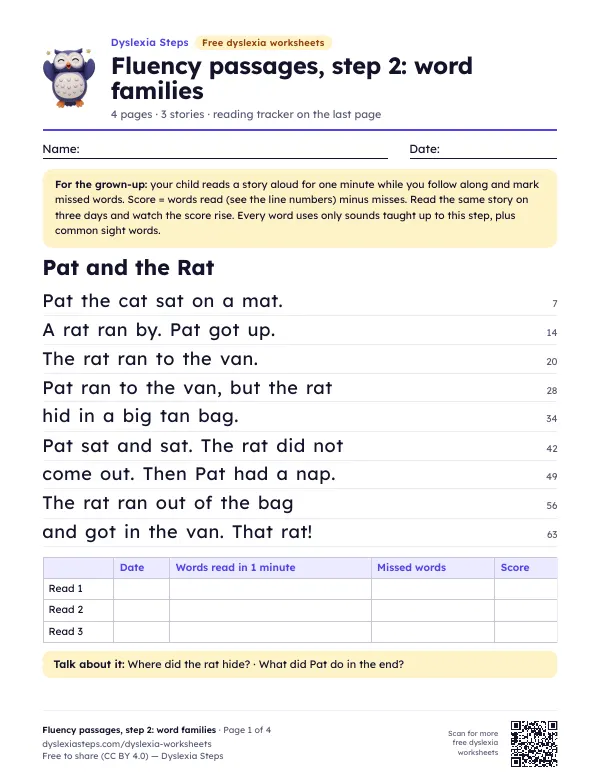
Fluency passages, step 2: word families
Three stories full of rhyming word families (-at, -an, -ig).
4 pages · 106 KB
Download PDF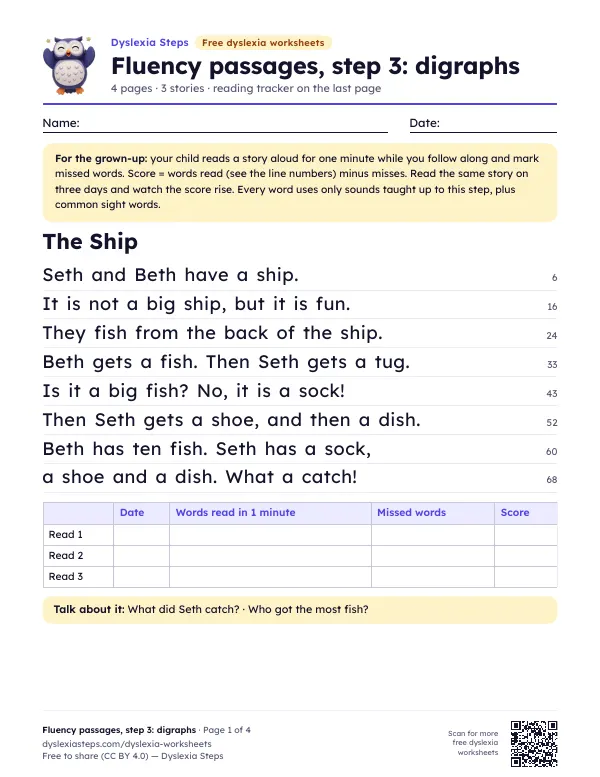
Fluency passages, step 3: digraphs
Three stories with sh, ch, th, wh and ck (ship, chip, duck).
4 pages · 105 KB
Download PDF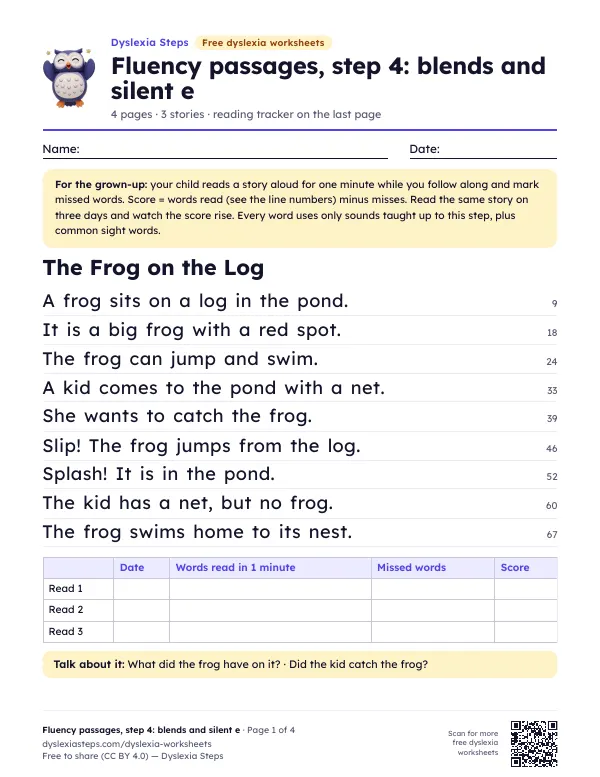
Fluency passages, step 4: blends and silent e
Three stories with blends and silent e (frog, jump, kite, cake).
4 pages · 106 KB
Download PDF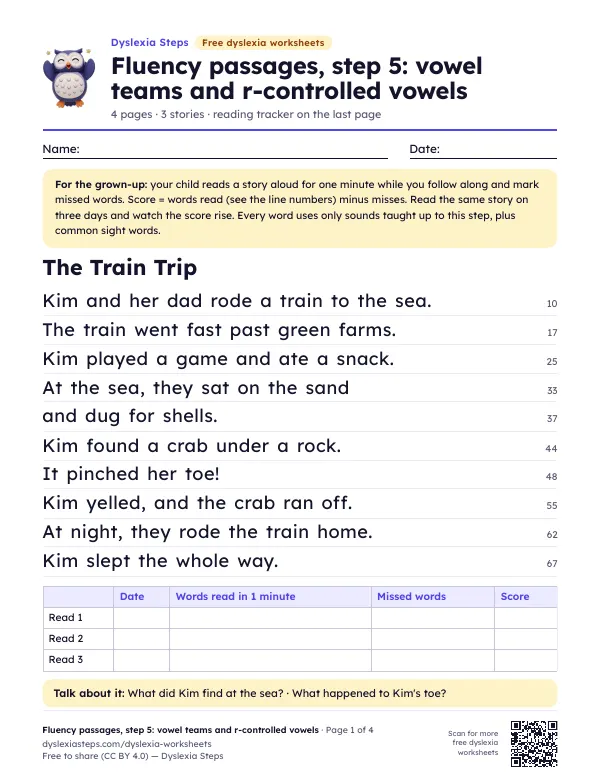
Fluency passages, step 5: vowel teams and r-controlled vowels
Three stories with vowel teams, ar/or/er and -ed (train, farm, played).
4 pages · 107 KB
Download PDF
Phonics worksheets for dyslexia, step by step
The fluency passages follow the same five steps as our 47 free phonics worksheets, which practise one sound pattern per pack. A common order for children who find reading hard:
- Short vowels in three-letter words (cat, pig, mud).
- Word families, where only the first sound changes (cat, hat, sat).
- Digraphs: two letters, one sound (sh, ch, th, ck).
- Consonant blends and silent e (frog, jump, cake, kite).
- Vowel teams, r-controlled vowels and -ed endings (rain, farm, jumped).
Sight words run alongside every step, a few at a time. Pair the phonics pack for a sound with the fluency passage for its step: first the sound on its own, then the sound inside a story.
Why these dyslexia worksheets work on sounds
Dyslexia is mainly a difficulty with the sounds inside words: hearing them, linking them to letters and holding them in order while reading and spelling. That is why the practice that helps most works directly on sounds and letters. A review of reading treatments for children with reading difficulties found that systematic phonics instruction was the approach with the clearest effect on both reading and spelling.
So nothing in these packs can be solved by guessing from a picture. The b and d pages start from the sound, the syllable pages break long words into parts a child can already read, and the fluency passages only use words your child has the tools to decode.
How to use dyslexia worksheets at home
- Keep it short. One page, five to ten minutes, on most days. Spaced practice is remembered better than one long session.
- Read the instructions aloud. They are written for a grown-up to read, so the reading effort goes into the target words, not the directions.
- Re-read the same story on three days. Reading the same text again is one of the best-studied ways to build reading fluency. The tracker on the last page of each fluency pack shows the score rising.
- Use mistakes as the next lesson. Check the page with the answer key straight away. Words that were hard today go on tomorrow's practice.
What makes these worksheets dyslexia-friendly
- One skill per pack and one activity per page.
- Large type, with extra space between letters, words and lines.
- No italic text, no busy pictures, no decorative fonts.
- Decodable stories: every word is checked against the sounds taught up to that step.
- An answer key or reading tracker on the last page, kept for the grown-up.
The type is Lexend, a clear sans-serif. We chose it because it is easy to read, not because a font fixes reading: studies of special dyslexia fonts have not found that they make reading better, and a systematic review found no good evidence that colored overlays help either. What helps is explicit, regular practice with sounds and letters.
b and d reversals: what dyslexia worksheets can and cannot do
Writing b for d is common in all beginning readers, and on its own it is not a sign of dyslexia. Reversals fade as children see the letters in many real words. The b and d packs keep the letters inside words and ask for the sound first, which links each shape to its sound rather than to a picture of the letter.
Worksheets are practice. They will not tell you whether your child has dyslexia, and they do not replace teaching at school. If reading stays hard after weeks of regular practice, the free dyslexia test screens six reading skills in about 8 minutes. It is a screening, not a diagnosis; only a qualified specialist can diagnose dyslexia.
Free to share (CC BY 4.0) — Dyslexia Steps.
Short answer
Where can I find free dyslexia worksheets?
Dyslexia Steps has 11 free printable dyslexia worksheet packs (55 pages): three for b and d mix-ups, three for syllables (clapping, compound words, splitting two-syllable words) and five decodable fluency passage packs, one per teaching step, with a one-minute reading tracker. Separately, 47 phonics worksheet packs cover each sound pattern.
- 11 PDF packs, 55 pages, free to print and share under CC BY 4.0, no sign-up.
- b and d packs link each letter to its sound first: listen and write b or d, trace and say, find and circle, sort, read sentences.
- Every word in the fluency passages uses only the sounds taught up to that step, plus common sight words; a script checks each word.
- Large type, extra spacing, no italics, no busy pictures, answer keys for the grown-up.
Free dyslexia worksheets: frequently asked questions
Are these dyslexia worksheets free?
Yes. All 11 packs are free PDFs with no sign-up and no email. They are licensed CC BY 4.0, so parents, tutors and teachers can print and share them as long as the Dyslexia Steps credit on each page stays.
Do worksheets help with b and d reversals?
Mixing up b and d is common in all beginning readers and is not a sign of dyslexia on its own. The b and d packs work on the sound first: your child hears the word, then writes the letter for the sound, and says the sound every time they trace or write it. That is more useful than drilling the two letter shapes on their own.
What is a decodable fluency passage?
A short story in which every word can be sounded out with the patterns your child has already been taught, plus a few common sight words. Your child reads it aloud for one minute on three different days and writes the score; reading the same text again is one of the best-studied ways to build fluency.
Which pack should we start with?
For reading practice, start with the fluency passages for the step your child is on: if the first story feels easy by the third read, move up a step. Use the b and d packs if those letters keep getting swapped, and the syllable packs once short words are steady and longer words cause trouble. For practice on one sound pattern at a time, see the phonics worksheets.
How long should a worksheet session take?
About 5 to 10 minutes, one page a day, on most days of the week. Short, spaced sessions are remembered better than one long session.
Can worksheets tell me if my child has dyslexia?
No. Worksheets are practice, not a test. If reading stays hard after weeks of regular practice, our free dyslexia test screens six reading skills in about 8 minutes. It is a screening, not a diagnosis; only a qualified specialist can diagnose dyslexia.
Sources
- Snowling MJ, Hulme C, Nation K (2020). Defining and understanding dyslexia: past, present and future. Oxf Rev Educ, 46(4), 501-513.
- Galuschka K, Ise E, Krick K, Schulte-Körne G (2014). Effectiveness of treatment approaches for children and adolescents with reading disabilities: a meta-analysis of randomized controlled trials. PLoS One, 9(2), e89900.
- Therrien WJ (2004). Fluency and comprehension gains as a result of repeated reading: a meta-analysis. Remedial Spec Educ, 25(4), 252-261.
- Cepeda NJ, Pashler H, Vul E, Wixted JT, Rohrer D (2006). Distributed practice in verbal recall tasks: a review and quantitative synthesis. Psychol Bull, 132(3), 354-80.
- Treiman R, Gordon J, Boada R, Peterson RL, Pennington BF (2014). Statistical learning, letter reversals, and reading. Sci Stud Read, 18(6), 383-394.
- Wery JJ, Diliberto JA (2017). The effect of a specialized dyslexia font, OpenDyslexic, on reading rate and accuracy. Ann Dyslexia, 67(2), 114-127.
- Kuster SM, van Weerdenburg M, Gompel M, Bosman AMT (2018). Dyslexie font does not benefit reading in children with or without dyslexia. Ann Dyslexia, 68(1), 25-42.
- Griffiths PG, Taylor RH, Henderson LM, Barrett BT (2016). The effect of coloured overlays and lenses on reading: a systematic review of the literature. Ophthalmic Physiol Opt, 36(5), 519-44.