Phonics word listEnglish Updated
Floss rule: ff, ll, ss and zz double consonant words
Floss rule words: 49 words in 5 groups, each with audio you can tap to hear. Practise them with two games (listen and find, build the word), 8 decodable sentences and a printable worksheet.
- words
- 49
- groups
- 5
- games
- 2
- sentences
- 8
- printable
- 🖨
Free dyslexia reading game
Floss rule words game: listen and find
Hear a word from the list and pick it from four look-alike words. Eight rounds, about two minutes.
- Free
- In your browser
- No download
- No sign-up
- 8 rounds
- about 2 min
- audio
The floss rule says: in a one-syllable word with a short vowel, double the f, l, s or z at the end. That is why we write puff, bell, miss and buzz. Hear every word, read the sentences, and play the game.
Floss rule words list (49 words)
Tap a word to hear it.
ff words (as in puff)
ll words (as in bell)
ss words (as in miss)
zz words (as in buzz)
Floss rule exceptions (one letter, short vowel)
Free dyslexia reading game
Floss rule words spelling game: build the word
Hear a word and build it from letter tiles, one sound at a time. Letter pairs like sh or ck come as one tile, because they spell one sound. Six rounds.
- Free
- In your browser
- No download
- No sign-up
- 6 rounds
- audio
Short answer
What is the floss rule?
The floss rule is an English spelling rule: when a one-syllable word has one short vowel and ends in f, l, s or z, the final letter is usually doubled, as in puff, bell, miss and buzz. The word floss itself follows the rule, which is where the name comes from. A few common words break it, such as if, bus, yes, gas and this. The same idea explains why short vowel words end in ck, as in ck words like duck and sock.
- The rule covers four letters: f, l, s and z (ff, ll, ss, zz).
- It applies to one-syllable words with one short vowel right before the final sound: puff, hill, mess, fizz.
- Common exceptions spell the sound with one letter: if, bus, yes, gas, this, us, pal, plus, quiz.
- Words where s sounds like /z/, such as is, has, his and was, are not floss words and keep a single s.
About floss rule words
The floss rule answers a question every young speller runs into: why does puff end in two f's but leaf only one? The rule is short. If a word has one syllable, one short vowel, and ends in the sound /f/, /l/, /s/ or /z/ straight after that vowel, double the last letter. Puff, bell, miss and buzz all fit. The word floss follows the rule itself, so teachers use it as the name: f, l, s, and in some programmes a z added at the end, written FLOSS or FLSZ. The doubled letters make one sound, so a child should hear four sounds in stuff, not five.
Every condition matters. The vowel must be short: leaf, feel and pool keep a single f, l or s because their vowel sounds are long. The final sound must follow the vowel directly: in milk or belt another consonant comes after the l, so nothing doubles. And the word must have one syllable: in longer words like until or pencil the rule does not apply. A related pattern covers the /k/ sound: after a short vowel at the end of a one-syllable word, /k/ is usually spelled ck, as in duck, sock and back. Some programmes teach floss and ck together as one idea, the short vowel needing two letters after it.
The exceptions are a small, stable group, and most of them are very common words: if, of, bus, yes, gas, this, us, pal, plus and quiz. They are worth a separate list, practised until the child spells them from memory, because they come up in almost every piece of writing. A second group looks like an exception but is not: is, has, his, as and was end in s, but the s says /z/, so the floss rule for s does not apply. Words with ll after a, such as all, ball, call and tall, do double the l, but the a does not make its short sound. Many programmes teach -all as its own chunk, alongside word families like -at.
Floss rule words in sentences
Decodable sentences: every word can be sounded out with the patterns on this page, plus a few very common words.
- The bell fell off the hill.
- Do not fuss in class.
- Jill will sniff the moss.
- Pass the glass to Bess.
- The bus is still at the cliff.
- Yes, this doll is a mess.
- The gull can puff and huff.
- I can smell the fizz in the glass.
Printable floss rule words worksheets (free PDF)
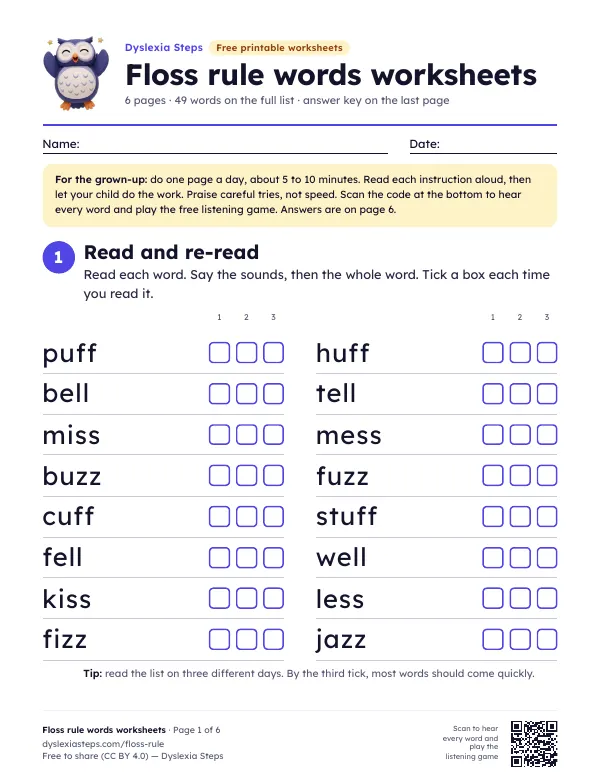
A 6-page pack built from this list, in large, clear type with plenty of space to write. Print it on US Letter paper; scan the code on each page to come back to the audio and the games.
- 1. Read and re-read: 16 words, three ticks each
- 2. Sound boxes: one box per sound, with a worked example
- 3. Missing letters: write the pattern into 10 words
- 4. Word sort: sort the words by pattern
- 5. Read the sentences: 8 short sentences to read aloud
- 6. Answer key for the grown-up
Free to share (CC BY 4.0) — Dyslexia Steps. Copy it for your class or your family.
Common mix-ups with floss rule words
Writing one letter (puf, bel, mis)
This is the most common floss mistake and shows the child is spelling by sound, which is good. Teach a quick check: one syllable, short vowel, ends in f, l, s or z? Then double it. Saying the four questions out loud for a week helps the habit stick.
Doubling after a long vowel (leaff, feell)
Once the rule is learned, some children double every final f, l or s. Go back to the vowel: is it short, like in pet, or does it say its name, like in feet? Sorting pairs such as fell and feel, or stuff and leaf, makes the vowel the deciding step.
Doubling the s in is, has and was
These words end in the letter s but the sound /z/. Ask the child to say the word and listen to the last sound. If it buzzes like a bee, it is a /z/ sound spelled with one s, and the floss rule does not apply.
Floss rule words activities
Floss sort
Write words on cards and have your child sort them into four piles: ff, ll, ss and zz. Add a fifth pile for exceptions such as bus, yes and if. Read each pile aloud at the end, tapping the vowel to check it is short.
Pull the floss
Hold a piece of dental floss or string. When your child spells a floss word aloud, they pull the string for the doubled letter: p, u, f, f. The movement marks the moment to write the second letter.
Fill the gap
Write words with the end missing, such as pu_, be_, mi_ and bu_. Your child hears the word, decides whether the final letter doubles, and fills in the gap. Mix in exceptions like bus so the rule has to be checked each time.
Short or long check
Say pairs such as fell and feel, toss and toes, stiff and leaf. Your child says which word has the short vowel and whether its last letter doubles. Spelling the short one on a whiteboard right after builds the link between the sound and the rule.
Floss rule words: frequently asked questions
What is the floss rule?
A spelling rule: when a one-syllable word has a short vowel and ends in f, l, s or z, double the last letter. Puff, bell, miss and buzz follow it, and so does the word floss.
What are some floss rule exceptions?
The common ones are if, of, bus, yes, gas, this, us, pal, plus and quiz. Words where s sounds like /z/, such as is, has, his and was, also keep one s, but they are not real exceptions because the final sound is not /s/.
What are double consonant words?
Words with the same consonant written twice in a row, such as bell, puff, dress and buzz. At the end of a short one-syllable word, doubling is mostly explained by the floss rule. In longer words, doubling also happens before endings, as in hopping and stopped, which follows a separate rule covered with ed ending words.
Do other letters double at the end of words?
Sometimes. Add, odd, egg, inn, err, butt and mitt end in doubled letters that the floss rule does not cover. They are rare, so most programmes teach them as a short list of extras. The /k/ sound after a short vowel is usually spelled ck instead, as in duck and back.
When do children learn the floss rule?
Usually in first grade, after they can read and spell short vowel words such as short a words and words with consonant blends. It is one of the first spelling rules taught, because it shows up in so many short words.