Phonics word listEnglish Updated
Word chains: 10 phonics chain examples, one sound at a time
Word chains: 65 words in 10 groups, each with audio you can tap to hear. Practise them with two games (listen and find, build the word), 8 decodable sentences and a printable worksheet.
- words
- 65
- groups
- 10
- games
- 2
- sentences
- 8
- printable
- 🖨
Free dyslexia reading game
Word chains game: listen and find
Hear a word from the list and pick it from four look-alike words. Eight rounds, about two minutes.
- Free
- In your browser
- No download
- No sign-up
- 8 rounds
- about 2 min
- audio
In a word chain, each new word changes just one sound from the word before: cat, hat, ham, jam. It trains children to look at every letter, not just the first one. Hear every word, read the sentences, and play the game.
Word chains list (65 words)
Tap a word to hear it.
Short a chain: cat → hat → ham → jam → jab → cab
Short vowel chain: sit → sat → sad → mad → mud → mug → bug
Short vowel chain: pin → pen → pet → pot → hot → hog → log
sh, ch, th chain: ship → shop → chop → chip → chin → thin
sh and th chain: rush → rash → cash → mash → math → path
ck chain: duck → luck → lock → sock → sack → back
Beginning blend chain: lap → clap → clip → slip → slap → flap → flat
Ending blend chain: ten → tent → tend → bend → band → hand → sand
Silent e chain: hop → hope → rope → rode → ride → hide → hid
Silent e chain: cap → cape → tape → tame → time → dime
Free dyslexia reading game
Word chains spelling game: build the word
Hear a word and build it from letter tiles, one sound at a time. Letter pairs like sh or ck come as one tile, because they spell one sound. Six rounds.
- Free
- In your browser
- No download
- No sign-up
- 6 rounds
- audio
Short answer
What are word chains in phonics?
A word chain is a list of words where each word differs from the one before by a single sound, such as cat, hat, ham, jam, jab, cab. The child reads or spells each word, noticing which sound changed: the first, the middle or the last. Chains can stay within short a words, swap vowels, or bring in digraphs like sh, consonant blends and silent e words. Because only one sound changes, the child has to check every letter instead of guessing from the first one.
- Each step changes, adds or removes exactly one sound: hat to ham, lap to clap.
- Changes move around the word: first sound, last sound, then the vowel, which is often the hardest.
- Chains can be read (decoding) or built with letter tiles (spelling).
- Start with CVC chains, then digraph, blend and silent e chains.
About word chains
A word chain is a sequence of real words where each word is made from the one before it by changing a single sound. In cat, hat, ham, jam, the first step swaps the first sound, the second swaps the last sound, and the third swaps the first sound again. Chains can also add a sound (lap to clap, ten to tent) or take one away (tent to ten). Word chaining appears in phonics teaching guides, including Wiley Blevins's Phonics from A to Z, as a way to make children attend to every position in a word. A child who reads by guessing from the first letter will read cat, then cat again for cab; a chain makes that habit visible at once.
A simple routine works for reading chains. Show the first word and have the child sound it out and read it. Then change one letter, with a tile, a whiteboard or a pencil, and ask: what changed? The child finds the new letter, says its sound, and reads the whole new word. For spelling chains, reverse the order: you say the new word, the child listens for which sound is different and swaps only that letter. Swapping one sound in a spoken word is a phonemic awareness skill; in the National Reading Panel's meta-analysis, phonemic awareness instruction helped children learn to read, and it helped more when it was taught with letters (Ehri and colleagues, 2001). In both versions of a chain, the vowel step, sit to sat or pot to pet, is often the hardest, because short vowels sound alike and sit in the middle of the word.
The ten chains on this page move through a typical phonics sequence. The first three use only short vowel CVC words. The next three bring in digraphs, two letters for one sound, so a step can change sh to ch while the number of sounds stays the same. The two blend chains add or swap a consonant in a cluster, which trains children not to drop a sound. The last two cross between short vowels and silent e words: hop becomes hope by adding an e, which changes the vowel sound without adding a sound of its own. Pick the chains that match what your child is learning now and keep them short; five or six words read well beat twenty read in a rush.
Word chains in sentences
Decodable sentences: every word can be sounded out with the patterns on this page, plus a few very common words.
- The cat sat on a hat.
- A bug is on the mug in the mud.
- The hog sat on a log in the hot sun.
- I can chop and I can chip.
- Dad has cash for the path.
- A duck and a sock are in the sack.
- Clap your hand on the flat sand.
- I hope to ride home on time.
Printable word chains worksheets (free PDF)
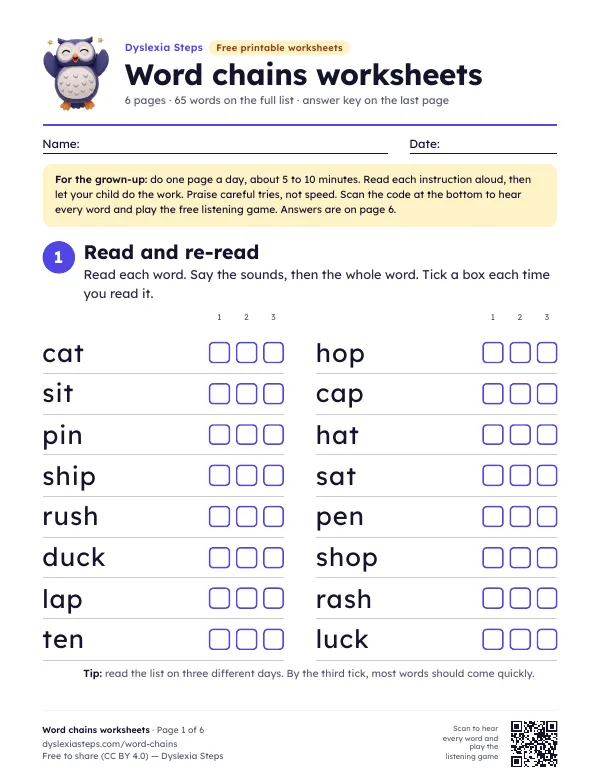
A 6-page pack built from this list, in large, clear type with plenty of space to write. Print it on US Letter paper; scan the code on each page to come back to the audio and the games.
- 1. Read and re-read: 16 words, three ticks each
- 2. Sound boxes: one box per sound, with a worked example
- 3. Change or add a sound: build the next word in a chain
- 4. Find and circle: spot the word among look-alikes
- 5. Read the sentences: 8 short sentences to read aloud
- 6. Answer key for the grown-up
Free to share (CC BY 4.0) — Dyslexia Steps. Copy it for your class or your family.
Common mix-ups with word chains
Reading the old word again (cat for cab)
The child sees a familiar shape and repeats the previous word. Before each read, ask them to point to the letter that changed and say its sound first. Only then do they read the whole word.
Changing too many letters when spelling
When you say the new word, the child may wipe the board and start again. Keep the old word in place and ask: which sound is different, the first, the middle or the end? Changing only one tile at a time is the point of the chain.
Missing the vowel change (pot read as pet)
Vowels are often the hardest step because they sit in the middle and sound alike. Slow down on vowel steps, stretch the vowel (p-ooo-t) and keep a vowel card with a picture for each short vowel nearby.
Word chains activities
Tile chain
Lay out letter tiles for the first word, such as c, a, t. Your child reads it. You swap one tile and they read again: hat, ham, jam. After a few chains, switch roles: you say the word and they make the swap.
Chain race on a whiteboard
Write the first word at the top. Your child writes each new word underneath as you say it, changing one letter. At the end, read the whole column top to bottom, then bottom to top.
Which sound changed?
Say two words from a chain aloud, such as mud and mug. Without looking at letters, your child says whether the first, middle or last sound changed. This is a listening version of the chain and works well in the car.
Make your own chain
Give your child a starting word and see how long a chain they can build with real words only. Write it down and read it back together. Made-up words do not count in this game, which makes them check meaning as well as sounds.
Word chains: frequently asked questions
What is a word chain?
A list of words where each word changes one sound from the word before, such as cat, hat, ham, jam. Children read or spell each new word by finding the sound that changed.
What are some word chain examples?
Short vowel: sit, sat, sad, mad, mud, mug, bug. Digraph: ship, shop, chop, chip, chin, thin. Blend: lap, clap, clip, slip, slap, flap, flat. Silent e: hop, hope, rope, rode, ride, hide, hid. All ten chains on this page are listed above with audio.
How do you do word chaining in phonics?
Show the first word and have the child read it. Change one letter, ask what changed, and have them say the new sound and read the new word. Repeat for five to eight words. For spelling, say each new word and have the child swap the one letter that is different.
What is the difference between word chains and word families?
In a word family such as the -at family, the ending stays the same and only the first sound changes: cat, hat, mat. In a word chain any sound can change, first, middle or last, so the child has to look at every letter.
When should children start word chains?
Once they can read a few CVC words, often in kindergarten. Begin with chains that change only the first or last sound, then add vowel changes, and move on to consonant blends, digraph and silent e chains as those patterns are taught.
Practise next
- Short a words45 wordsbat · cat · hat · mat · pat · rat
- Sh words42 wordsship · shop · shed · shell · shelf · shin
- Consonant blends38 wordsclap · flag · glad · plan · slip · blob
- Silent e words44 wordscake · make · bake · lake · game · name
- At family words25 wordsbat · cat · hat · mat · pat · rat
- Nonsense words44 wordsvap · maf · zab · laz · wab · mep