Phonics word listEnglish Updated
Ed ending words: the three sounds of past tense -ed
Ed ending words: 36 words in 3 groups, each with audio you can tap to hear. Practise them with two games (listen and find, build the word), 8 decodable sentences and a printable worksheet.
- words
- 36
- groups
- 3
- games
- 2
- sentences
- 8
- printable
- 🖨
Free dyslexia reading game
Ed ending words game: listen and find
Hear a word from the list and pick it from four look-alike words. Eight rounds, about two minutes.
- Free
- In your browser
- No download
- No sign-up
- 8 rounds
- about 2 min
- audio
The past tense ending -ed is spelled the same way in every regular verb, but it has three sounds: /t/ in jumped, /d/ in played and /id/ in wanted. Hear every word, read the sentences, and play the game.
Ed ending words list (36 words)
Tap a word to hear it.
-ed says /t/ (after p, k, s, f, sh, ch, x)
-ed says /d/ (after voiced sounds and vowels)
-ed says /id/ (after t or d, adds a syllable)
Free dyslexia reading game
Ed ending words spelling game: build the word
Hear a word and build it from letter tiles, one sound at a time. Letter pairs like sh or ck come as one tile, because they spell one sound. Six rounds.
- Free
- In your browser
- No download
- No sign-up
- 6 rounds
- audio
Short answer
What are the three sounds of -ed?
The past tense ending -ed makes three sounds. After a voiceless sound such as /p/, /k/, /s/, /f/, /sh/ or /ch/, it says /t/: jumped, kicked, wished. After a voiced sound or a vowel, it says /d/: played, filled, hugged. After /t/ or /d/, it adds a syllable and says /id/: wanted, needed, landed. The spelling is always -ed, which is why children need to learn to read it as one ending rather than sounding out e and d.
- -ed says /t/ after voiceless sounds: jumped, looked, fixed, watched.
- -ed says /d/ after voiced sounds and vowels: played, called, rained, lived.
- -ed says /id/ and adds a syllable after t or d: wanted, needed, painted, ended.
- Spelling changes come first: stop becomes stopped, live becomes lived, cry becomes cried.
About ed ending words
Regular English verbs make the past tense by adding -ed: jump becomes jumped, play becomes played, want becomes wanted. In writing, the ending never changes. In speech it has three forms, and which one you hear depends on the last sound of the base word. This is a rule children can test with their own voice. Put a hand on the throat and say /p/, then /b/. With /p/ the throat stays still; that is a voiceless sound. With /b/ it buzzes; that is a voiced sound. The -ed ending copies whatever came before it.
After a voiceless sound, /p/, /k/, /s/, /f/, /sh/, /ch/ or /ks/ as in x, -ed says /t/: jumped, kicked, passed, wished, watched, fixed. After a voiced consonant such as /b/, /g/, /l/, /m/, /n/, /v/ or /z/, or after a vowel sound, -ed says /d/: grabbed, hugged, filled, turned, lived, buzzed, played. After /t/ or /d/, the ending would be impossible to hear, so English adds a vowel and a whole extra syllable: want-ed, need-ed, land-ed. That third group is the easiest to hear and the easiest to spell, because every sound is there. The first two groups cause most spelling mistakes, because children who spell by ear write jumpt or playd.
Three spelling changes happen before -ed is added, and they are usually taught after the sounds. When a one-syllable word ends in one short vowel and one consonant, the consonant doubles: stop becomes stopped, hug becomes hugged, grab becomes grabbed. When a word ends in a silent e, only d is added: live becomes lived, hope becomes hoped. When a word ends in a consonant and y, the y changes to i: cry becomes cried. Doubling matters for reading, too: hopped has a short o and hoped has a long o, and the double p is what tells the reader which one it is. Irregular verbs such as ran, sat, went and saw do not use -ed and are learned separately.
Ed ending words in sentences
Decodable sentences: every word can be sounded out with the patterns on this page, plus a few very common words.
- Sam jumped and kicked the ball.
- Mom cooked and I helped.
- It rained, so we stayed in.
- Dad filled the cup and I added milk.
- The bee buzzed and landed on the plant.
- We painted, then we rested.
- Kim wanted a dog and needed a pet bed.
- The ice melted when the sun started to shine.
Printable ed ending words worksheets (free PDF)
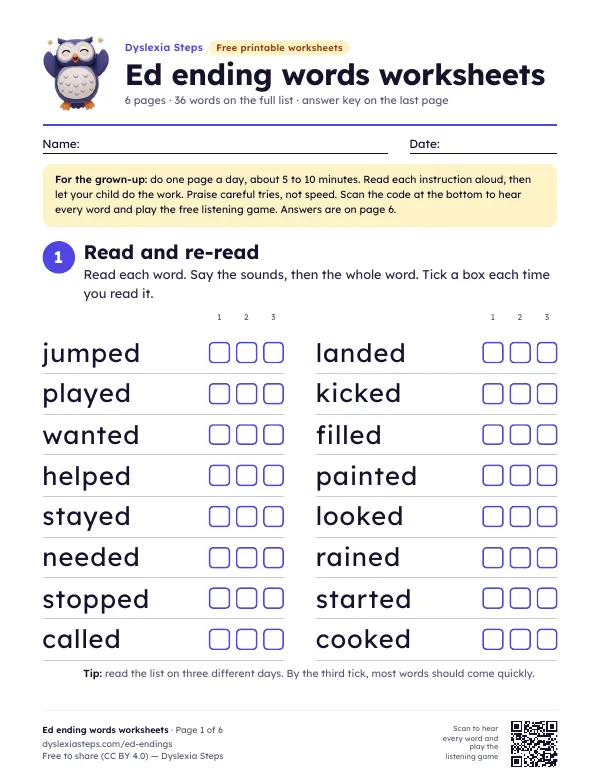
A 6-page pack built from this list, in large, clear type with plenty of space to write. Print it on US Letter paper; scan the code on each page to come back to the audio and the games.
- 1. Read and re-read: 16 words, three ticks each
- 2. Sound boxes: one box per sound, with a worked example
- 3. Missing letters: write the pattern into 10 words
- 4. Word sort: sort the words by pattern
- 5. Read the sentences: 8 short sentences to read aloud
- 6. Answer key for the grown-up
Free to share (CC BY 4.0) — Dyslexia Steps. Copy it for your class or your family.
Common mix-ups with ed ending words
Spelling by ear (jumpt, playd)
The child hears /t/ or /d/ and writes it. Praise the listening, then teach the rule: if it happened in the past, the ending is spelled -ed, whatever it sounds like. Have them say the base word first, jump, then add the ending, jumped.
Reading every -ed as /id/ (jump-ed)
Children who sound out letter by letter may add a syllable to every word. Point to the letter before -ed: is it t or d? If not, the ending stays short and does not add a beat. Clapping the syllables, one clap for jumped and two for wanted, makes the difference audible.
Mixing up hoped and hopped
Without the doubling rule, both words look like hop plus an ending. Write them side by side and underline the double p. One consonant after the vowel plus e means a long vowel (hoped); a double consonant keeps the vowel short (hopped).
Ed ending words activities
Throat buzz test
Your child puts two fingers on their throat and says the base word slowly: jump, play, want. Does the last sound buzz? No buzz means /t/; a buzz means /d/; a t or d at the end means /id/. Sort the word into the right column.
Three-pocket sort
Label three cups or envelopes /t/, /d/ and /id/. Read each card aloud together and drop it in the matching pocket. At the end, read all the words in each pocket in a row so the child hears the shared sound.
Yesterday story
Ask your child to tell you three things they did yesterday using words from the list: I played, I helped, I painted. Write the sentences down together and circle every -ed. Then read them back and say which sound each ending made.
Base word plus ending
Write the base word on one card and -ed on another. Your child reads the base word, slides the ending next to it and reads the new word. For words like stop and hug, add a card with the extra letter so the doubling step becomes visible.
Ed ending words: frequently asked questions
What are the three sounds of -ed?
/t/ as in jumped, /d/ as in played and /id/ as in wanted. The sound depends on the last sound of the base word: voiceless gives /t/, voiced or a vowel gives /d/, and t or d gives /id/.
How do you know which -ed sound to use?
Say the base word and listen to its last sound. If it is t or d, the ending says /id/. If your throat buzzes on the last sound, as with l, n, g or a vowel, it says /d/. If it does not buzz, as with p, k, s, f, sh or ch, it says /t/.
When do you double the consonant before -ed?
When the base word has one syllable, one short vowel and ends in one consonant: stop to stopped, hug to hugged. This keeps the vowel short. Words like jump and help already end in two consonants, so nothing doubles. The same short vowel idea is behind the floss rule.
What are some ed ending words for kids?
Good first words have a short vowel and an easy base: jumped, helped, kicked, filled, hugged, rested, landed and melted. Children who can read consonant blends can read most of them, because the base word is a word they already know.
When do children learn the past tense -ed?
Many programmes introduce reading -ed in first grade, as one of the first word endings along with -s and -ing, and teach the spelling changes (doubling, dropping e, y to i) across first and second grade. Programmes differ in the exact order.