Phonics word listEnglish Updated
Long e words: every spelling of the long e sound
Long e words: 57 words in 8 groups, each with audio you can tap to hear. Practise them with two games (listen and find, build the word), 8 decodable sentences and a printable worksheet.
- words
- 57
- groups
- 8
- games
- 2
- sentences
- 8
- printable
- 🖨
Free dyslexia reading game
Long e words game: listen and find
Hear a word from the list and pick it from four look-alike words. Eight rounds, about two minutes.
- Free
- In your browser
- No download
- No sign-up
- 8 rounds
- about 2 min
- audio
Long e words have the vowel sound you hear in tree, sea, me and happy, the sound of the letter e's own name. Here are 57 of them, grouped by how the sound is spelled, with audio for every word.
Long e words list (57 words)
Tap a word to hear it.
ee words (as in tree)
ea words (as in sea)
Open syllable e (as in me)
e_e words (as in these)
y words (as in happy)
ie words (as in field)
ey words (as in key)
ei words (as in ceiling)
Free dyslexia reading game
Long e words spelling game: build the word
Hear a word and build it from letter tiles, one sound at a time. Letter pairs like sh or ck come as one tile, because they spell one sound. Six rounds.
- Free
- In your browser
- No download
- No sign-up
- 6 rounds
- audio
Short answer
What are long e words?
Long e words contain the /ē/ sound, the name of the letter e, as in tree, sea, me and happy. The most common spellings are ee (see, green) and ea (eat, sea). Long e is also spelled with a single e at the end of a short word or syllable (me, she, even), with y at the end of a longer word (happy, candy), and less often with ie (field), ey (key), e_e (these) and ei (ceiling).
- ee and ea are the two most common spellings of long e.
- ea can also say short e (head, bread) and, in a few words, long a (great).
- Y at the end of a word of two or more syllables usually says long e: happy, puppy, city.
- Unlike a_e and i_e, the silent e pattern e_e is rare; these and theme are the main short examples.
- ie says long e in field and chief, but long i in pie and tie.
About long e words
The long e sound is the sound of the letter e's name, /ē/, as in tree, sea and me. It is the long partner of the short e in bed and pet. Some of the first words children ever read, me, he, we, she and be, already have it: a single e at the end of a short word says its name, because nothing closes it in. Children usually meet the ee spelling next, because it is very regular. Almost every ee word says long e, which makes it a good team to practise first.
Long e is unusual among the long vowels because its silent e pattern, e_e, is rare. Long a, i and o have dozens of everyday silent e words; long e has these, theme and a group of longer words such as complete and compete. In practice, most long e words children read are spelled with ee or ea. The ea spelling is the tricky one. It says long e in eat, sea and dream, but short e in head, bread and breakfast, and long a in great and steak. Teach children to try long e first, because it is the most common, and to switch if the word does not make sense.
Two other spellings come up often in reading. Y at the end of a longer word, as in happy, puppy and city, says long e in American English, while y at the end of a one-syllable word, as in my and fly, says long i. And ie says long e in field, chief and piece. Note that ie also says long i in pie and tie, so position and word length help decide. If your child confuses ee and ea when spelling, that is normal; the choice has to be learned word by word, through reading and sorting rather than a rule.
Long e words in sentences
Decodable sentences: every word can be sounded out with the patterns on this page, plus a few very common words.
- We see three green trees.
- She can eat a peach at the beach.
- The queen has a key.
- He keeps the sheep in the field.
- My puppy is happy to sleep.
- The monkey has a piece of peach.
- We dream of a sunny beach.
- Pete and Steve will compete as a team.
Printable long e words worksheets (free PDF)
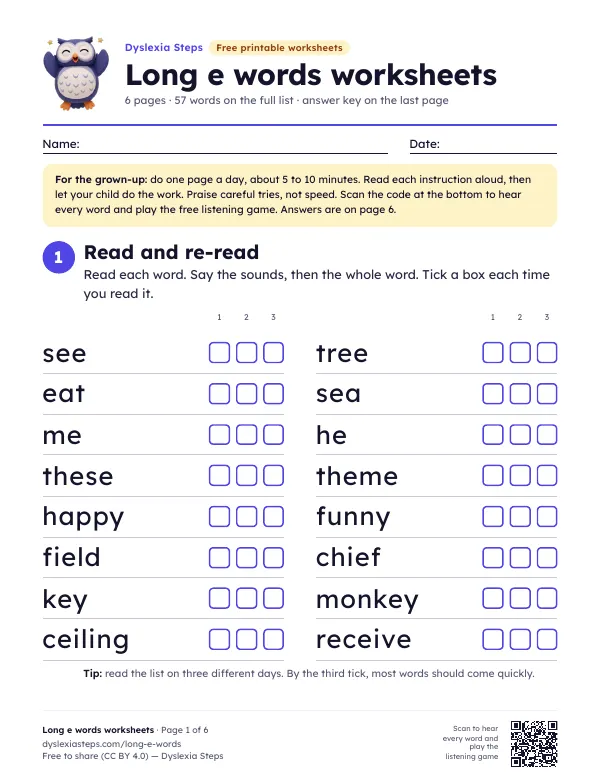
A 6-page pack built from this list, in large, clear type with plenty of space to write. Print it on US Letter paper; scan the code on each page to come back to the audio and the games.
- 1. Read and re-read: 16 words, three ticks each
- 2. Sound boxes: one box per sound, with a worked example
- 3. Missing letters: write the pattern into 10 words
- 4. Word sort: sort the words by pattern
- 5. Read the sentences: 8 short sentences to read aloud
- 6. Answer key for the grown-up
Free to share (CC BY 4.0) — Dyslexia Steps. Copy it for your class or your family.
Common mix-ups with long e words
ea read as short e (or short e words read as long)
A child who reads head as heed is using the most common sound of ea, which is the right first try. Teach the check: does the word make sense? If not, try short e. Keep a small list of short ea words, such as head, bread, dead and ready, and practise them together.
ee or ea when spelling (sleap, grean)
Both spell the same sound and no rule tells you which one a word uses. Sort words into an ee column and an ea column, and read the columns aloud often. Homophones help here: see and sea, meet and meat, week and weak. Pairing them with their meanings makes the spelling stick.
Final y: long e or long i? (happy, my)
Children who learn that y says long i in my and fly may read happy as hap-pie. Count the syllables: in a word of one syllable, final y says long i; in a word of two or more syllables, it usually says long e. Clap the syllables before reading.
Long e words activities
ee and ea columns
Make two columns headed ee and ea. Say words from this page one at a time; your child picks a column, writes the word and checks it against the list. At the end, read each column aloud. Many children start to remember which spelling looks right after a few rounds.
Homophone pairs
Write see and sea, meet and meat, week and weak, and peek and peak on cards. Say a short sentence such as 'We swim in the sea', and your child holds up the right spelling. This links the spelling to meaning, which is how ee and ea words are remembered.
Clap and check the y
Write my, happy, fly, puppy, sky and candy on cards. Your child claps the syllables, then reads the word. One clap means the y says long i; two or more claps mean it says long e. Sort the cards into two piles.
Long e word hunt
Read a short book together. Each time your child hears the long e sound, they say 'e!' and point to the word. Afterwards, write the words you found and sort them by spelling. Count which spelling turned up most.
Long e words: frequently asked questions
What is the long e sound?
It is the sound of the letter e's own name, /ē/, as in tree, sea, me and happy. It is different from the short e in bed and pet. All five long vowels are compared on the long vowel words page.
What are 5 words with ee and ea?
With ee: see, tree, feet, green and sleep. With ea: eat, sea, leaf, team and beach. Both teams spell long e. More are on the vowel teams page.
Does bee have a long e?
Yes. The ee in bee spells the long e sound, the same sound as in see, tree and three. Almost every ee word in English says long e.
Why does the y in happy say long e?
When y comes at the end of a word with two or more syllables, it usually says long e: happy, funny, city. In one-syllable words such as my and sky it says long i. See long i words for the other half of the pattern.
Are there silent e words with long e?
Yes, but only a few short ones: these and theme are the main examples, plus longer words such as complete, delete and compete. Long e is usually spelled with ee or ea instead. The silent e words page has e_e words next to the other vowels.
Is ea always long e?
No. ea says long e in most words (eat, sea, dream), short e in some common ones (head, bread, ready) and long a in a few (great, break, steak). Try long e first, then the others if the word does not make sense.
Practise next
- Long vowel words30 wordscake · rain · day · eight · paper · great
- Short e words27 wordsget · jet · let · met · net · pet
- Vowel teams44 wordsrain · tail · mail · paint · train · snail
- Silent e words44 wordscake · make · bake · lake · game · name
- Long a words57 wordscake · make · game · name · gate · lake
- Long i words60 wordsbike · kite · time · five · hide · ride