Phonics word listEnglish Updated
Long vowel sounds: the 5 long vowels and how to spell them
Long vowel words: 30 words in 5 groups, each with audio you can tap to hear. Practise them with two games (listen and find, build the word), 8 decodable sentences and a printable worksheet.
- words
- 30
- groups
- 5
- games
- 2
- sentences
- 8
- printable
- 🖨
Free dyslexia reading game
Long vowel words game: listen and find
Hear a word from the list and pick it from four look-alike words. Eight rounds, about two minutes.
- Free
- In your browser
- No download
- No sign-up
- 8 rounds
- about 2 min
- audio
A long vowel says its own letter name: a in cake, e in tree, i in kite, o in home and u in cute. Hear 30 long vowel words, see the main spellings of each sound, and play the game.
Long vowel words list (30 words)
Tap a word to hear it.
Long a (cake, rain, day, eight, paper, great)
Long e (tree, sea, me, these, happy, field)
Long i (kite, night, pie, my, find, tiger)
Long o (home, boat, snow, go, toe, cold)
Long u (cute, rule, blue, new, fruit, music)
Free dyslexia reading game
Long vowel words spelling game: build the word
Hear a word and build it from letter tiles, one sound at a time. Letter pairs like sh or ck come as one tile, because they spell one sound. Six rounds.
- Free
- In your browser
- No download
- No sign-up
- 6 rounds
- audio
Short answer
What are the long vowel sounds?
English has five long vowel sounds, one for each vowel letter: long a as in cake, long e as in tree, long i as in kite, long o as in home and long u as in cute. A long vowel says the name of its letter. Each sound has several spellings: a vowel with a silent e (cake), a vowel team (rain, boat), a vowel at the end of a syllable (go, paper) and a few rarer ones (eight, night). Children usually meet long vowels in first grade, after short vowels.
- A long vowel says its letter name: /ā/, /ē/, /ī/, /ō/ and /ū/ (or /yoo/).
- Three clues usually signal a long vowel: a silent e at the end, a vowel team, or a vowel at the end of a syllable.
- Long u has two common pronunciations: /yoo/ as in cute and /oo/ as in rule.
- The letter y can spell long i (my, fly) or long e (happy, baby).
- Common Core lists long vowel spellings in first grade (RF.1.3.c) and telling long from short vowels in second grade (RF.2.3.a).
About long vowel words
Every vowel letter has a short sound and a long sound. The short sounds are the ones in cat, bed, sit, hot and cup. The long sounds are easier to remember because each one says the name of its letter: a in cake, e in tree, i in kite, o in home and u in cute. That is why teachers say a long vowel 'says its name'. The word long is a teaching label, not a measure of time; a long vowel is a different sound from the short one, not a stretched version of it. Long u is the one that needs extra care. Its letter name is /yoo/, as in cute, music and few, but after letters such as r, l and j, and in American English usually after t, d and n, it is said /oo/, as in rule, blue and tube. Most phonics programmes teach both under long u.
The tricky part is spelling. Each long vowel sound can be written several ways, and the same word list looks very different depending on which spelling it uses. Long a, for example, is a_e in cake, ai in rain, ay in day, eigh in eight, a on its own in paper and even ea in great. A good order is to start with the silent e pattern, then the most common vowel teams, then open syllables, then the rarer spellings. Our separate pages give every common spelling of each sound, grouped and with audio: long a words, long e words, long i words, long o words and long u words.
Readers decide whether a vowel is long by looking at what comes after it. A silent e at the end of the word (kite), a second vowel next to it (boat, rain) or the end of a syllable (go, ti-ger) all point to a long vowel. A single vowel closed in by a consonant (kit, got) usually points to a short one. These clues are reliable for the words children meet first, but English spelling is less consistent than that of most European languages, so some very common words break the pattern: have, give, come and some look long but are short. Teach those words separately, and keep the rule for the many words where it works.
Long vowel words in sentences
Decodable sentences: every word can be sounded out with the patterns on this page, plus a few very common words.
- I like to ride my bike in the rain.
- We see a goat on the road.
- The cute mule ate a green leaf.
- Go home, it is time to sleep.
- Eight blue kites fly high.
- The baby has a new coat.
- She can play a tune on the flute.
- My dog hid a bone in the snow.
Printable long vowel words worksheets (free PDF)
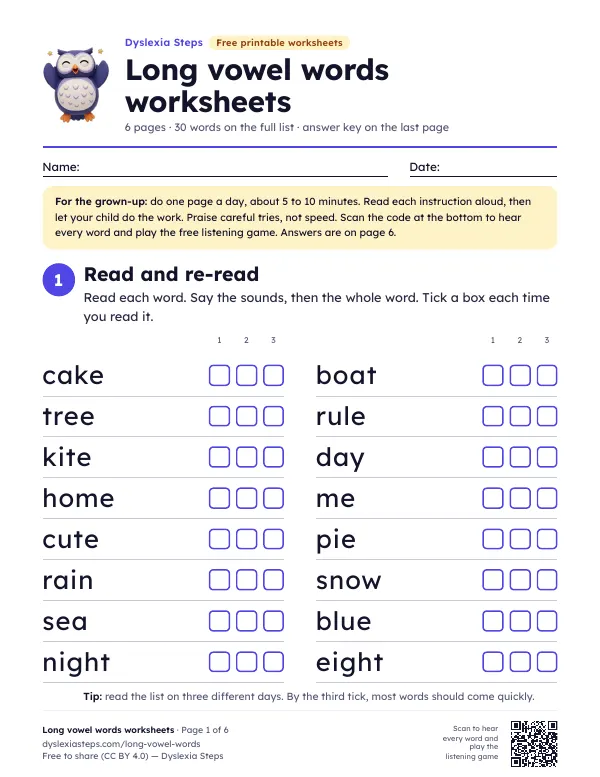
A 6-page pack built from this list, in large, clear type with plenty of space to write. Print it on US Letter paper; scan the code on each page to come back to the audio and the games.
- 1. Read and re-read: 16 words, three ticks each
- 2. Sound boxes: one box per sound, with a worked example
- 3. Missing letters: write the pattern into 10 words
- 4. Word sort: sort the words by pattern
- 5. Read the sentences: 8 short sentences to read aloud
- 6. Answer key for the grown-up
Free to share (CC BY 4.0) — Dyslexia Steps. Copy it for your class or your family.
Common mix-ups with long vowel words
Reading every vowel short (kite as kit, boat as bot)
Children who have practised CVC words for months often read the first vowel short out of habit. Teach them to scan the whole word before sounding it out: is there an e on the end, or a second vowel next to the first one? If so, try the long sound, the letter name, first.
Mixing up which letter name goes with which sound (e and i)
Some children know that long vowels say their names but stumble on which name goes with which letter, especially e and i: the letter e is named /ē/ and the letter i is named /ī/. Practise the five names as sounds, not just as alphabet letters: point to a, say /ā/; point to e, say /ē/.
Using the long sound on short exception words (have, give, come)
Once the silent e rule clicks, children may read have to rhyme with cave and come to rhyme with home. That shows they have learned the rule. Praise the attempt, tell them the word is a rule breaker, and keep a short list of these words to practise as whole words.
Long vowel words activities
Short or long sort
Write pairs such as cap and cape, bed and bead, kit and kite, hop and hope, cub and cube on cards. Your child reads each card aloud and sorts it into a short pile and a long pile. Ask each time what told them the vowel was long.
Say its name
Hold up a vowel card and say a word aloud, such as rain or cup. Your child gives a thumbs up if they hear the vowel saying its name and a thumbs down if they hear the short sound. This trains the ear before any spelling is involved.
One sound, many spellings
Pick one long vowel, such as long o. Make columns for o_e, oa, ow and o on its own. Say words such as home, boat, snow and go; your child writes each in the right column, then reads every column aloud. Seeing the columns side by side shows that one sound has several spellings.
Mark the vowel
On a printed list, your child draws a straight line (a macron) over each long vowel, as in the dictionary sign ā, and a small curve over each short vowel. Marking the vowel with a pencil while saying the sound links the hand, the eye and the ear.
Long vowel words: frequently asked questions
What are the 5 long vowel sounds?
Long a as in cake, long e as in tree, long i as in kite, long o as in home and long u as in cute. Each one says the name of its vowel letter. See the full lists for long a words, long e words, long i words, long o words and long u words.
What does it mean when a vowel says its name?
It means the vowel sounds exactly like the letter's name in the alphabet. In cake you hear the name of the letter a; in cat you hear the short sound instead. That is the simplest way to tell a long vowel from a short one.
How do you know if a vowel is long or short?
Look at what comes after it. A silent e at the end of the word (silent e words such as kite), a second vowel next to it (vowel teams such as boat) or the end of a syllable (go, tiger) usually make it long. A vowel closed in by a consonant, as in short a words such as cat, is usually short.
Is y a long vowel?
Y is not one of the five vowel letters, but it often spells a long vowel sound. At the end of a one-syllable word it says long i (my, fly, sky); at the end of a longer word it usually says long e (happy, baby, candy).
What are some examples of long vowel words?
Long a: cake, rain, day. Long e: tree, sea, me. Long i: kite, night, my. Long o: home, boat, go. Long u: cute, blue, new. Each example uses a different spelling of the same sound.
When do children learn long vowels?
Usually in first grade, after short vowel words, blends and digraphs. Common Core expects first graders to know final e and common vowel team spellings for long vowels, and second graders to tell long and short vowels apart when reading. Programmes differ in the exact order.
Practise next
- Long a words57 wordscake · make · game · name · gate · lake
- Long e words57 wordssee · tree · bee · feet · green · sleep
- Long i words60 wordsbike · kite · time · five · hide · ride
- Long o words57 wordshome · bone · rope · hole · nose · note
- Long u words47 wordscute · cube · mule · use · huge · fume
- Silent e words44 wordscake · make · bake · lake · game · name
- Vowel teams44 wordsrain · tail · mail · paint · train · snail
Sources
- National Governors Association Center for Best Practices & Council of Chief State School Officers (2010). Common Core State Standards for English Language Arts, Reading: Foundational Skills (K-5).
- Seymour PHK, Aro M, Erskine JM (2003). Foundation literacy acquisition in European orthographies. Br J Psychol, 94(2), 143-74.