Phonics word listEnglish Updated
The an word family: -an words list
An family words: 25 words in 3 groups, each with audio you can tap to hear. Practise them with two games (listen and find, build the word), 8 decodable sentences and a printable worksheet.
- words
- 25
- groups
- 3
- games
- 2
- sentences
- 8
- printable
- 🖨
Free dyslexia reading game
An family words game: listen and find
Hear a word from the list and pick it from four look-alike words. Eight rounds, about two minutes.
- Free
- In your browser
- No download
- No sign-up
- 8 rounds
- about 2 min
- audio
Can, fan, man and van all end in -an. It is one of the most common word families in early books. Listen to each word, read the sentences and play the game.
An family words list (25 words)
Tap a word to hear it.
CVC -an words
-an words with blends and digraphs
Longer words ending in -an
Free dyslexia reading game
An family words spelling game: build the word
Hear a word and build it from letter tiles, one sound at a time. Letter pairs like sh or ck come as one tile, because they spell one sound. Six rounds.
- Free
- In your browser
- No download
- No sign-up
- 6 rounds
- audio
Short answer
What is the an word family?
The an word family is the group of words that end in the rime -an, the short a sound followed by n, as in can, fan, man and van. Children read them by blending the first sound with -an: f + an, fan. The family also includes words that start with two consonants, such as plan and scan, and longer words such as snowman, suntan and caravan.
- The rime -an is short a followed by /n/, as in pan.
- Short a before n often sounds slightly nasal and drawn out in American English.
- Some phonics programmes teach -an as a single unit, sometimes called a welded or glued sound.
- Adding a silent e makes a long a word: can becomes cane and man becomes mane.
About an family words
The -an rime is short a followed by /n/. In General American English the vowel changes a little before n: it becomes nasal and can sound almost like two sounds, so man may come out close to mee-an. That is normal speech, not a mistake, but it means the a in fan does not sound exactly like the a in cat. Some phonics programmes deal with this by teaching -an as one glued chunk rather than two separate sounds.
Start with the eight three-letter words, where the only change is the first letter. Then move to the blends group. Plan, scan, clan and bran all begin with two consonants that are both heard, while than begins with the digraph th, two letters for one sound. The longer words show -an at the end of a compound word (snowman, dustpan, suntan) and of longer words like caravan and orangutan.
Can is also one of the most common words in early reading books, as in I can run. Because children meet it so often, it is a good anchor word: once can is secure, ask what happens if the c becomes f, m, p or v. Read the pairs can/cane and man/mane later on to introduce the silent e pattern.
An family words in sentences
Decodable sentences: every word can be sounded out with the patterns on this page, plus a few very common words.
- The man ran to the van.
- I can fan the hot pan.
- Dad has a plan for the van.
- The snowman has a tan hat.
- A toucan sat on the caravan.
- Can the orangutan get the pan?
- The fan began to spin.
- Get the dustpan and the saucepan.
Printable an family words worksheets (free PDF)
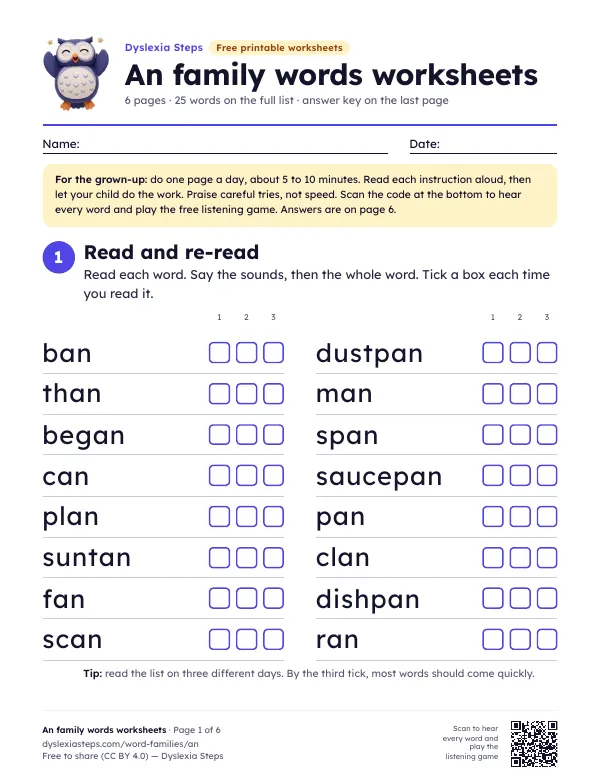
A 6-page pack built from this list, in large, clear type with plenty of space to write. Print it on US Letter paper; scan the code on each page to come back to the audio and the games.
- 1. Read and re-read: 16 words, three ticks each
- 2. Sound boxes: one box per sound, with a worked example
- 3. Missing letters: write the pattern into 10 words
- 4. Word sort: sort the words by pattern
- 5. Read the sentences: 8 short sentences to read aloud
- 6. Answer key for the grown-up
Free to share (CC BY 4.0) — Dyslexia Steps. Copy it for your class or your family.
Common mix-ups with an family words
-an and -en (pan and pen)
Short a and short e are close together, and in parts of the American South pen and pin also merge. Say pairs slowly, pan/pen, man/men, tan/ten, and let your child watch your mouth: short a opens wider.
-an and -and (ban and band)
Once children know -an, they may drop the d in band or hand. Read the two side by side and have them tap one finger per sound: b-a-n is three taps, b-a-n-d is four.
Can and cane
A silent e changes can into cane and man into mane. If your child reads both words the same way, cover the e, read, uncover it, read again. The vowel is the part that changes.
An family words activities
Pan of letters
Put magnetic letters b, c, f, m, p, r, t and v in a pan. Place -an on the fridge or a baking tray. Your child pulls a letter from the pan, sets it in front of -an, and reads the word.
Fan fold
Fold a strip of paper like a fan. Write -an on the last fold and a different first letter on each of the others. Opening one fold at a time shows a new word; your child reads each one as it appears.
Real or silly
Mix real -an words with made-up ones such as zan, lan or gan on cards. Your child reads each card and puts it on a real pile or a silly pile. Reading nonsense words checks true blending, not memory.
Stretch and snap
Hold a stretchy band or a hair tie. Stretch it while saying the sounds slowly, p-aaa-n, then let it snap back while saying pan fast. It gives a feel for blending the start onto the chunk.
An family words: frequently asked questions
What words are in the an word family?
The three-letter ones are ban, can, fan, man, pan, ran, tan and van. Longer -an words include than, plan, scan, span, began, snowman, dustpan, saucepan, caravan and orangutan.
Why does the a in man sound different from the a in cat?
In American English, short a before n or m is usually nasal and a little longer. It is the same vowel spelled the same way, so children read it as short a, but it can help to teach -an as one chunk.
Should I teach -an before -at?
Either order works. Many programmes start with -at, then -an, because -at is easier to hear clearly. The important thing is to teach one family at a time and review both often.
Is 'can' a sight word?
Can is a high-frequency word, but it is decodable: /k/ /a/ /n/. Children can sound it out, which is more reliable than memorising its shape.